19 Data Science Project Ideas for Beginners

 Written by:
Tihomir Babic
Data science projects are crucial for job finding. They let you learn and show that you can do the actual work in practice, not just blabber about it.
Projects are what separate candidates who understand data science from those who can actually do it.
If you spend your months just reading about data science and watching tutorials, you won’t get the job. You probably know that from experience.
Creating a GitHub repo, a notebook, or a deployed model requires you to build something tangible. It shows how you apply your knowledge in practice using real data. It shows what you do when you hit the wall.
Hitting the wall and finding your way around it, this is what the interviewers want to see. They know that’s exactly how skills get built. And that the data science job is all about hitting walls.
In this article, we’ll help you not freeze when the interviewer asks to see your work. You’ll learn how to pick the right project for your level and goals, where to find them, and how to turn your work into a portfolio that gets you a data science career.
How to Choose a Data Science Project
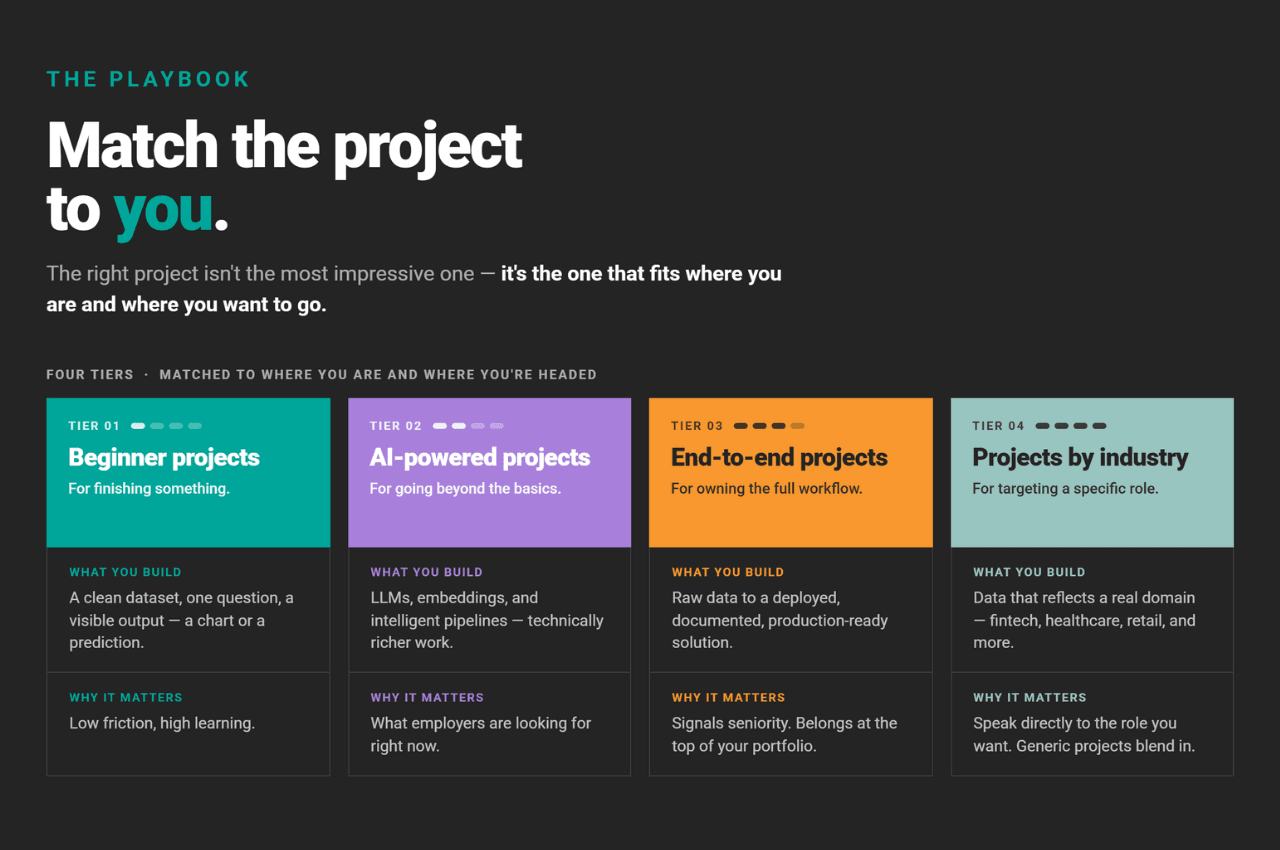
Beginner Data Science Project Ideas
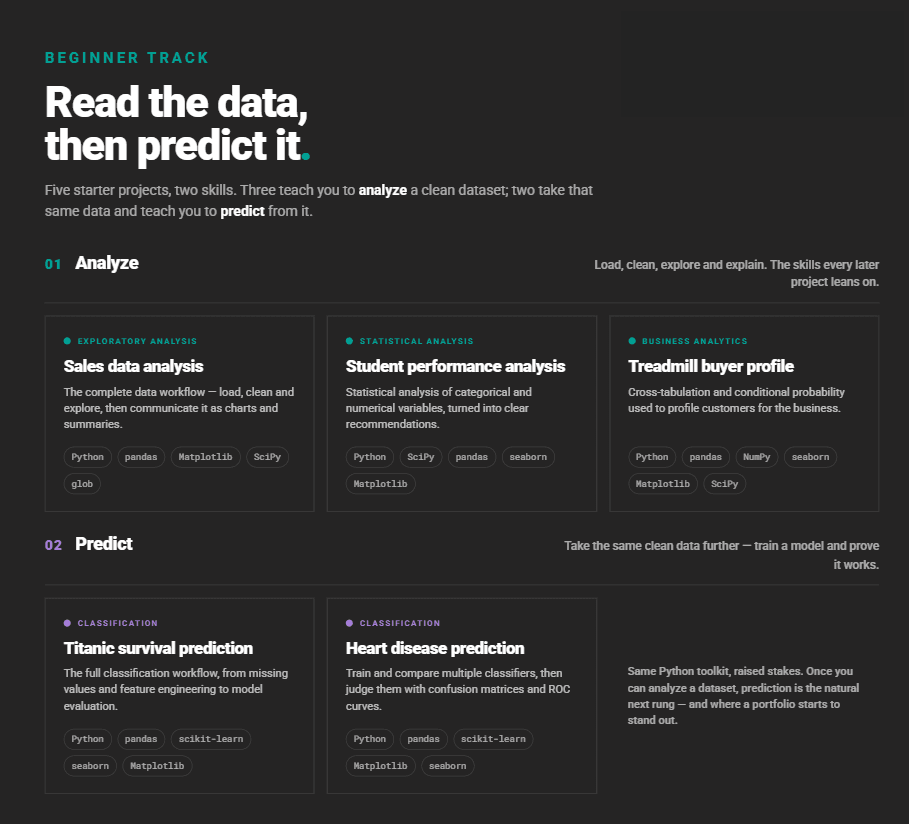
These projects are meant to handle (usually clean) datasets and answer clear questions. You’ll practice coding on real datasets and end up with a working notebook to show for it.
If you're also exploring data mining projects, we cover those separately.
1. Sales Data Analysis
What you’re solving: Analyzing 23andMe’s sales data to uncover trends, patterns, and performance insights.
This project is a great learning starting point for data analytics projects, because anyone can understand its outputs: charts and summaries.
It focuses on the data workflow, where you’ll load, clean, and explore data, before you communicate findings. You’ll solidify your Python, pandas and plotting libraries skills.
What you’ll learn:
- Loading, cleaning, and manipulating data with pandas
- Building time series visualizations and spotting trends
- Summarizing data statistically and communicating findings
Tools used: Python, pandas, Matplotlib, SciPy, glob
Project link: Sales Data Analysis
2. Student Performance Analysis
What you’re solving: Analyzing a Pearson dataset to understand how demographic, social, and school-related factors impact student grades.
It’s a very suitable project because its education data is very intuitive, and most of you will already have a feeling of what matters for student performance. That way, you won’t spend too much energy understanding data and will be able to focus on actual analysis.
Interviewers love it when you show social awareness alongside technical skills, and this project is perfect for that.
What you’ll learn:
- Statistical analysis of categorical and numerical variables
- Data visualization
- Providing insights and recommendations
Tools used: Python, SciPy, pandas, seaborn, Matplotlib
Project link: Student Performance Analysis
3. Treadmill Buyer Profile
What you’re solving: Building a customer profile for Aerofit to match them with ideal treadmills using cross-tabulation and probability analysis.
This project will teach you how to think like a business analyst, which means tying what the data says with actual products and their customers. It’s a very concrete project that will make cross-tabulation and conditional probability less intimidating.
After this one, you’ll know how to use any raw customer data to provide business insights.
What you’ll learn:
- Creating and interpreting cross-tabulations and contingency tables
- Calculating and applying conditional probability
- Translating statistical findings into business recommendations
Tools used: Python, pandas, NumPy, seaborn, Matplotlib, SciPy
Project link: Treadmill Buyer Profile
4. Titanic Survival Prediction
What you’re solving: You’re using passenger data to predict who survived the sinking.
This is the most widely attempted beginner project in data science for good reason. However, the other side of the coin is that the recruiters immediately dismiss it if they see it in your portfolio. So, don’t use it for that, but for building skills.
The main skill you’re building here is the full classification workflow from feature engineering to model evaluation.
Due to the project’s popularity, the dataset is well-documented, and the community is huge. You can compare your approach against thousands of others.
What you’ll learn:
- Handling missing values and encoding categorical features
- Training and evaluating a classification model with scikit-learn
- Interpreting model performance with accuracy, precision, and recall
Tools used: Python, pandas, scikit-learn, seaborn, Matplotlib
Dataset: Kaggle Titanic Dataset
Resource: GitHub tutorial Repo
5. Heart Disease Prediction
What you’re solving: Predicting the existence of heart disease in a patient, using data such as age, cholesterol, resting blood pressure, and chest pain type.
The dataset is relatively small and clean, which is perfect for beginners. This is an emotionally compelling project to work on, as there are real stakes. It forces you to think about what a false negative actually means.
What you’ll learn:
- Encoding categorical variables and scaling numerical features
- Training and comparing multiple classification algorithms with scikit-learn
- Evaluating a model using accuracy, confusion matrices, and ROC curves
Tools used: Python, pandas, scikit-learn, Matplotlib, seaborn
Dataset: UCI Heart Disease Dataset
Resource: GitHub Tutorial Repo
AI-Powered Data Science Projects
The AI projects sit at the intersection of data science and modern AI, which is what the industry is looking for right now. If you want your portfolio to look up-to-date, these projects are a must!
Working on these projects will take you beyond classical machine learning. You’ll be working with language models, embeddings, and intelligent pipelines.
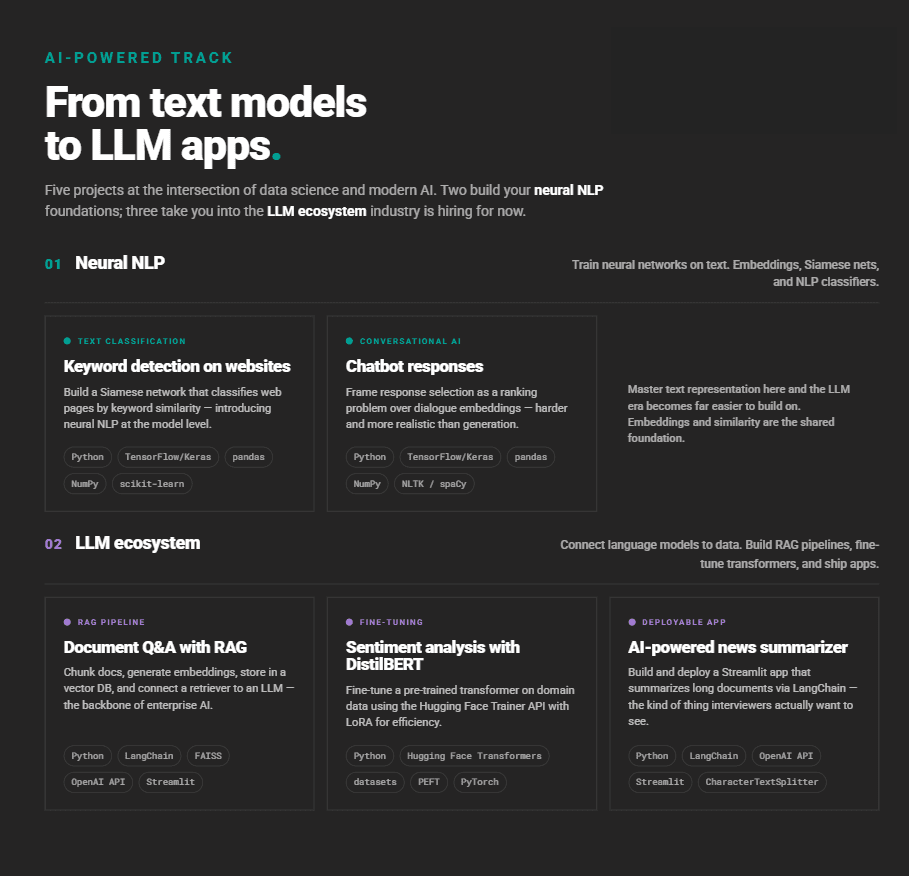
6. Keyword Detection on Websites
What you’re solving: Your task is to create an algorithm for PeakData. The algorithm should classify medical web pages according to certain keywords using neural networks and text vectorization.
This project introduces you to NLP at the model level: you’re actually building a system that understands text. A valuable skill that it teaches you is using the Siamese network architecture. It underpins many real-world applications, ranging from document similarity to semantic research.
What you’ll learn:
- Vectorizing text and representing it numerically for neural network input
- Building and training a Siamese network for text similarity tasks
- Evaluating NLP model performance beyond simple accuracy
Tools used: Python, TensorFlow/Keras, pandas, NumPy, scikit-learn
Project link: Keyword Detection on Websites
7. Chatbot Responses
What you’re solving: Exploring incomplete dialogue transcripts for a Spectrm chatbot and mapping the correct answers.
This project gives you real data from a real company to work on one of the most in-demand applied NLP skills: conversational AI. You’re working on response selection, which is a harder and more realistic problem than response generation. Why? You have to think about semantic similarity, context representation, and ranking. These skills are all transferable to production chatbots and recommendation systems.
What you’ll learn:
- Presenting conversational context as numerical embeddings
- Framing response selection as a ranking or classification problem
- Working with sequential text data and dialogue structure
Tools used: Python, TensorFlow/Keras, pandas, NumPy, NLTK, or spaCy
Project link: Chatbot Responses
8. RAG-Based Document Q&A System
What you’re solving: Building a retrieval-augmented generation (RAG) pipeline. It lets users ask questions in natural language about a document collection and get answers.
RAG is behind most of today’s enterprise AI applications, from internal knowledge bases to customer support bots. Learning how to connect a retriever to an LLM, manage context windows, and ground responses in source documents will make you insanely employable.
What you’ll learn:
- Chunking documents, generating embeddings, and storing them in a vector database
- Building a RAG pipeline with FAISS and connecting it to an LLM via LangChain
- Evaluating answer quality and handling edge cases in RAG systems
Tools used: Python, LangChain, FAISS, OpenAI API or open-source LLM, Streamlit
Dataset: Use any PDF or document collection of your choice.
Resource: GitHub – RAG Projects with LangChain + FAISS
9. Sentiment Analysis With a Fine-Tuned LLM
What you’re solving: Fine-tuning a pre-trained language model (DistilBERT) on the IMDB dataset to classify movie reviews as positive or negative.
Using a pre-trained model out of the box is one thing. Fine-tuning it on domain-specific data is another. This project will teach you the Hugging Face ecosystem end-to-end, meaning you’ll learn how to load a model, configure a training loop with the Trainer API, and evaluate on held-out data.
That alone is worth doing it. In addition, all those skills are directly transferable to any NLP classification task in any domain.
What you’ll learn:
- Loading and tokenizing datasets using the HuggingFace
datasetslibrary - Fine-tuning a transformer model using the Trainer API with LoRA for efficiency
- Evaluating model performance and running inference on new data
Tools used: Python, Hugging Face Transformers, datasets library, PEFT, PyTorch
Dataset: IMDB Dataset via Hugging Face
Resource: GitHub – SentimentFineTuning with DistilBERT
10. AI-Powered News Summarizer
What you’re solving: Building a Streamlit app that takes a news article URL or text as input and returns a concise AI-generated summary using LangChain and an LLM.
While summarization seems simple, it’s not. Some of the challenges you deal with in this project are handling long documents, maintaining factual accuracy, and deploying as an interactive app.
That deployable app is what interviewers are looking for, so the project is ideal for your portfolio.
What you’ll learn:
- Building a text summarization chain with LangChain and an LLM
- Handling long documents using text splitting strategies
- Building and deploying an interactive AI app with Streamlit
Tools used: Python, LangChain, OpenAI API, Streamlit, CharacterTextSplitter
Dataset: Any news article or web content
Resource: GitHub — LangChain Text Summarization App
End-to-End Data Science Projects
The interviewers love candidates who can own a project. To build that skill, you’ll have to work on end-to-end projects. They will teach you independent decision-making in every project stage: data cleaning, feature engineering, model selection, evaluation, and deployment.
Have several of those at the top of your portfolio to signal your seniority.
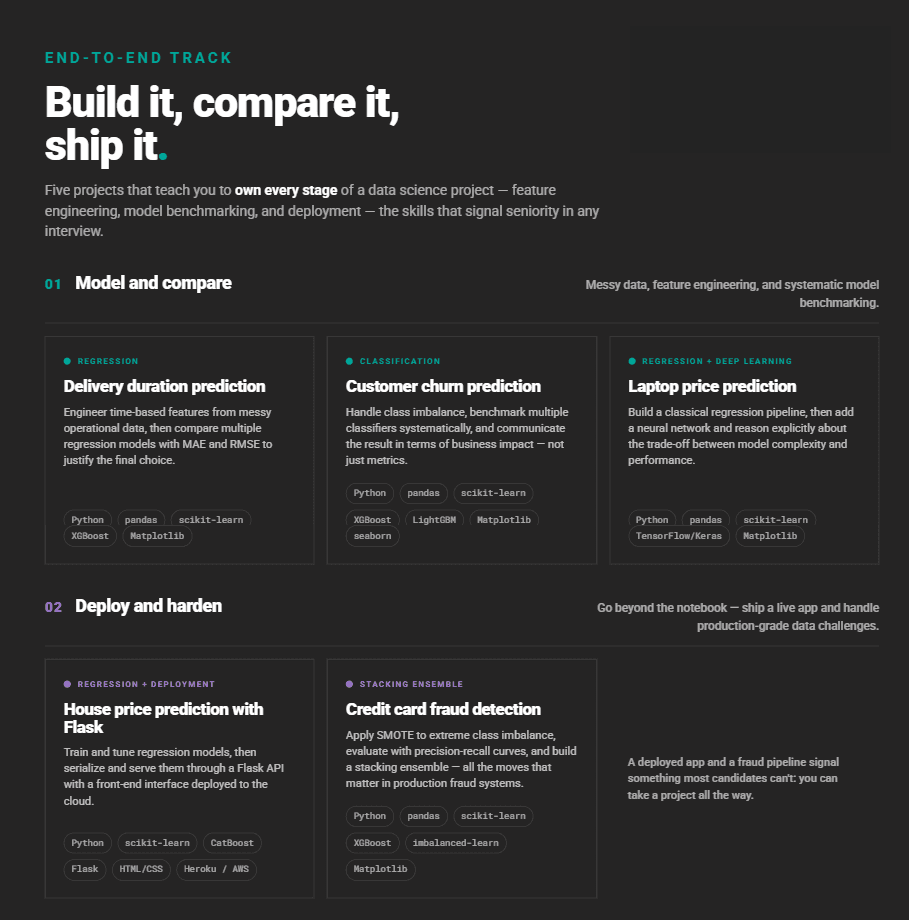
11. Delivery Duration Prediction
What you’re solving: Predicting order arrival times for DoorDash using stacked regression with prep-time decomposition.
Not only is it a textbook end-to-end regression project, but it also has a genuine business impact: every error in your work leads to prediction errors, which, in turn, translates to customer dissatisfaction.
The data you’ll work with is messy, as it will be on the job, and requires significant engineering efforts. You’ll also learn how to compare multiple models and choose the best.
What you’ll learn:
- Engineering time-based and categorical features from raw operational data
- Comparing regression models systematically and justifying your final choice
- Evaluating prediction quality with MAE, RMSE, and residual analysis
Tools used: Python, pandas, scikit-learn, XGBoost, Matplotlib
Project link: Delivery Duration Prediction
12. Customer Churn Prediction
What you’re solving: Predicting telecom churn for Sony using multi-model benchmarking and drift-aware deployment.
This, too, is a classic end-to-end project. Not surprisingly, since churn prediction is among the most common real-world data science tasks. In this project, you’ll not just pick one algorithm. You’ll be building a framework for evaluating many algorithms and explaining your final choice.
That reasoning, along with the churn prediction signaling job readiness, is why this project should find its way to your portfolio.
What you’ll learn:
- Handling class imbalance in a classification problem
- Building, comparing, and tuning multiple classifiers systematically
- Communicating model results in terms of business impact, not just metrics
Tools used: Python, pandas, scikit-learn, XGBoost, LightGBM, Matplotlib, seaborn
Project link: Customer Churn Prediction
13. Laptop Price Prediction
What you’re solving: Defining and training a machine learning model for Allegro that will predict laptop prices via VIF-filtered features and weighted Voting Regressor.
This is not your typical regression project. Here, you’re moving on from classical models to a neural network implementation. You’ll learn how to build a comparison framework and how to reason about the value added by deep learning models. (Speaking of, here are other deep learning project ideas.) In other words, the skill you’re working on is architectural thinking.
What you’ll learn:
- Cleaning and encoding hardware specifications data for modeling
- Building and comparing a regression pipeline against a neural network
- Evaluating and interpreting trade-offs between model complexity and performance
Tools used: Python, pandas, scikit-learn, TensorFlow/Keras, Matplotlib
Project link: Laptop Price Prediction
14. House Price Prediction With Flask Deployment
What you’re solving: Predicting California housing prices from the Kaggle dataset and deploying the trained model as a live web application using Flask.
Most data science projects end at the notebook. Not this one. You’ll deploy a model to a web interface, where a user can input features and receive a prediction in real time. Again, something tangible like that is what interviewers simply love to see in portfolios.
What you’ll learn:
- Building and tuning regression models, including CatBoost, RandomForest, and LightGBM
- Serializing a trained model and serving it through a Flask API
- Building a front-end interface and deploying the full application to the cloud
Tools used: Python, scikit-learn, CatBoost, Flask, HTML/CSS, Heroku, or AWS
Dataset: California Housing Prices on Kaggle
Resource: GitHub — End-to-End House Price Prediction With Flask
15. Credit Card Fraud Detection Pipeline
What you’re solving: Building a complete fraud detection system on a highly imbalanced dataset.
The fraud detection problem is difficult to solve because even a model that predicts “not fraud” for every transaction will be 99% accurate, while being completely useless at the same time.
With this project, you will learn how to handle severe class imbalance with SMOTE, evaluate with precision-recall curves (instead of accuracy), and build a stacked ensemble.
What you’ll learn:
- Applying SMOTE oversampling to handle extreme class imbalance
- Using stratified cross-validation and tuning hyperparameters with GridSearchCV
- Building and evaluating a stacking ensemble with RandomForest, XGBoost, and other classifiers
Tools used: Python, pandas, scikit-learn, XGBoost, imbalanced-learn, Matplotlib
Dataset: Credit Card Fraud Dataset on Kaggle
Resource: GitHub – End-to-End Fraud Detection Pipeline
Data Science Projects by Industry
Whenever possible, you should work on projects that are industry-specific. This will help you understand the domain better, making you a better and more employable data scientist.
Each project in this section is here because it mirrors the kind of work data scientists actually do in that industry, with data structures, problem framing, and business questions that reflect that reality.
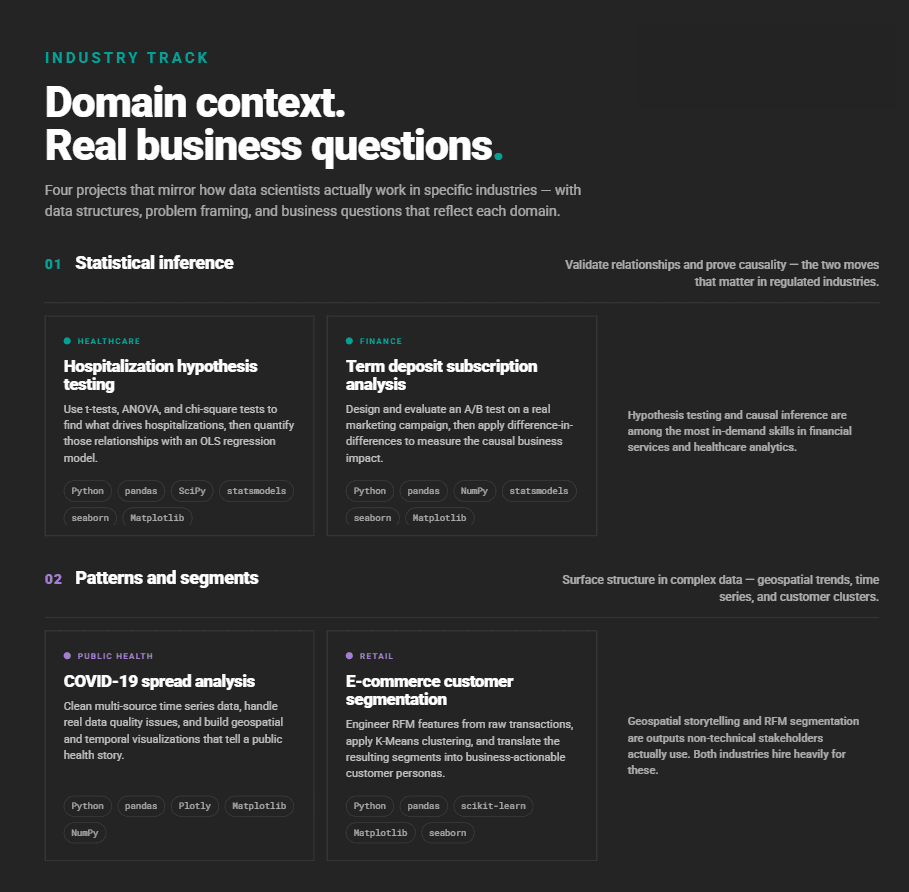
16. Hospitalization Hypothesis Testing (Healthcare)
What you’re solving: Decoding regional patterns in the Apollo Hospitals’ dataset to determine which medical and demographic factors are statistically associated with longer or more costly hospitalizations.
You’ll learn a common pattern used in healthcare: use hypothesis testing to validate relationships and regression models (specifically OLS) to quantify them.
What you’ll learn:
- Formulating and testing hypotheses on real clinical data using t-tests, ANOVA, and chi-square tests
- Building and interpreting an OLS regression model to explain hospitalization charges
- Communicating statistical and regression findings in a healthcare context
Tools you’ll use: Python, pandas, SciPy, statsmodels, seaborn, Matplotlib
Project link: Hospitalization Hypothesis Testing on StrataScratch
17. Term Deposit Subscription Analysis (Finance)
What you’re solving: Analyze the Portuguese bank’s client features and campaign history to determine whether the marketing campaign resulted in more customers subscribing to a term deposit.
This project teaches you how to prove that a specific action caused a certain outcome. You’ll do that with A/B testing and difference-in-differences analysis, which are very much sought-after skills in financial services analytics.
What you’ll learn:
- Designing and evaluating an A/B test on real marketing campaign data
- Applying difference-in-differences analysis to measure causal impact
- Communicating findings in terms of campaign effectiveness and business ROI
Tools used: Python, pandas, NumPy, statsmodels, seaborn, Matplotlib
Project link: Term Deposit on StrataScratch
18. COVID-19 Spread Analysis (Public Health)
What you’re solving: You’re analyzing global COVID-19 data to identify spread patterns, compare country-level responses, and visualize the trajectory of the pandemic over time.
Johns Hopkins’ COVID-19 dataset is one of the most comprehensive historical records of a global health crisis ever compiled. For the public health data science project, you can’t have better than that. You’ll face real-world data quality issues. You’ll build geospatial and temporal visualizations. Those are the skills that the public health employers are looking for.
What you’ll learn:
- Cleaning and merging multi-source historical time series datasets
- Building geospatial and temporal visualizations for public health data
- Reasoning about data quality and the limits of available evidence
Tools used: Python, pandas, Plotly, Matplotlib, NumPy
Dataset: Johns Hopkins COVID-19 Dataset on GitHub
Resource: GitHub — COVID-19 Data Analysis With Python
19. E-Commerce Customer Segmentation (Retail)
What you’re solving: Segmenting customers of a UK-based online retailer using RFM analysis and K-Means clustering to identify distinct purchasing personas.
RFM segmentation – Recency, Frequency, Monetary – is the industry-standard framework for understanding customer behavior. Combine it with K-Means clustering, and you have a project that any e-commerce and retail data interviewer will recognize in your portfolio.
What you’ll learn:
- Engineering RFM features from raw transaction-level data
- Applying K-Means clustering and determining the optimal number of segments
- Interpreting and presenting customer segments as business-actionable personas
Tools used: Python, pandas, scikit-learn, Matplotlib, seaborn
Dataset: Online Retail Dataset on Kaggle
Resource: GitHub – RFM Segmentation with K-Means
Where to Find Datasets for Data Science Projects
The dataset you choose to work with defines what and how much you learn. It’ll also ultimately define what your portfolio looks like and how seriously employers will take your work.
Here are the best resources for finding datasets.
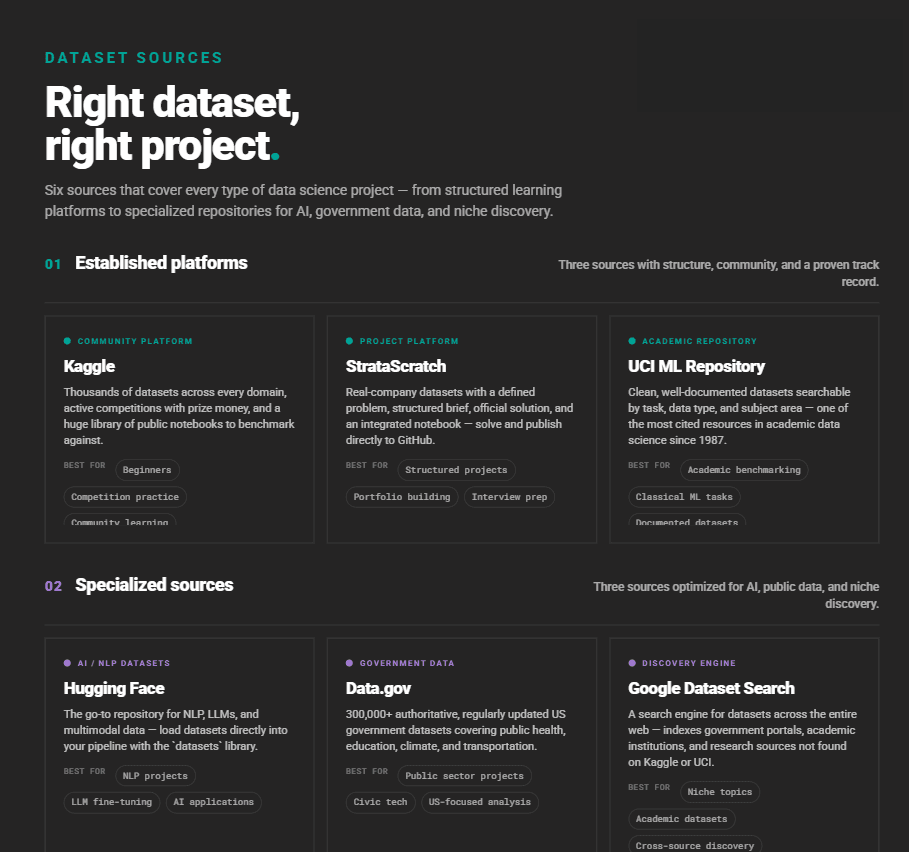
Kaggle
Kaggle is the default starting point for most data science projects. There’s a reason for that: thousands of datasets across every possible domain and skillset. On top of that, there are active competitions with real prize money and a huge community that produces public notebooks you can learn from.
Best for: Beginners, competition practice, community learning
StrataScratch
Strata Projects goes beyond the raw dataset. Each project is from a real company, and has a clearly defined problem, a structured brief, and an official solution. You can solve them directly on the platform, as it has integrated notebooks. Then you can post your solution to your GitHub repository and use it as a part of your portfolio.
Best for: Structured projects, portfolio building, interview preparation
UCI Machine Learning Repository
The UCI repository is a great resource for classical machine learning project ideas. It’s a huge repository that has been around since 1987 and is still one of the most cited resources in academic data science. This means there’s a wealth of prior work to benchmark against.
The datasets are clean, well-documented, and you can search them by keywords, attributes, data type, subject area, task, and other criteria.
Best for: Academic benchmarking, classical ML tasks, well-documented datasets
Hugging Face
Hugging Face is a relatively new repository and has become the go-to for NLP and AI datasets. This repository is perfect if you’re working on language models, fine-tuning, text classification, summarization, or any task involving unstructured text or multimodal data.
You can easily load data directly into your pipeline with the datasets library.
Best for: NLP projects, LLM fine-tuning, AI-powered applications
Data.gov
Data.gov is the US government’s open data portal. It has over 300,000 datasets covering everything, from public health and education to climate and transportation. The data is authoritative, regularly updated, and free.
Best for: Public sector projects, civic tech, US-focused industry analysis
Google Dataset Search
Google Dataset Search is just like a regular Google, but for datasets. It indexes datasets from across the web, including government portals, academic institutions, and research organizations that don't appear on Kaggle or UCI. When you have a specific topic in mind and the usual sources come up empty, this is where to look next.
Best for: Niche topics, academic datasets, cross-source discovery
How to Build a Data Science Portfolio That Gets Interviews
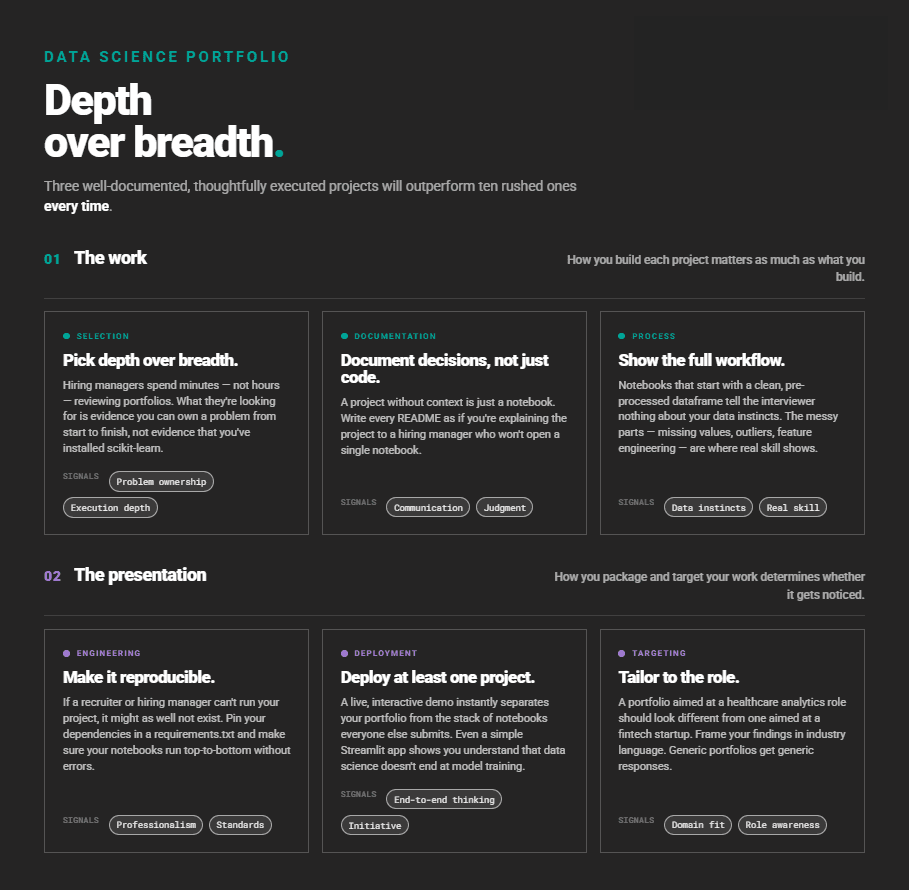
The point of a data science portfolio is to get you the job. The stakes are high, so most data scientists make a crucial mistake: they cram in every possible project without context or narrative.
However, a large collection of notebooks is not a portfolio – it’s a graveyard of talent. The only way a portfolio can get you a job is if it unambiguously shows what you can actually do.
FAQs
1. What is a good beginner data science project?
As a beginner, look for three things: a clean dataset, a clear question, and a visible output. Not having to fight with data allows you to focus on learning tools and the workflow: loading, exploring, modeling, and communicating.
2. How many data science projects should I have?
There’s no definitive number. Focus on quality, not quantity.
However, three to five quality projects should be enough for most positions. More than that will dilute the portfolio quality. Or you’ll have a bloated portfolio with projects overlapping too much.
3. What project should I put on my resume?
Include projects that best match the skills and tools required for the role and the industry.
For example, a data analyst role at a healthcare company requires statistical analysis skills and proficiency with tools such as Python, SciPy, and statsmodels. At the top of your portfolio should then be, for example, a hypothesis-testing project on hospitalization.
Remove all the projects that are irrelevant to the role and industry. The closer the match between what you build and the requirements, the higher the chance you’ll land the job.
4. Are Kaggle projects enough?
No.
Kaggle projects are a good starting point. However, their advantages – pre-cleaned data, pre-defined problem, thousands of candidates doing the same projects – become disadvantages relatively quickly.
Use Kaggle for learning and for showing baseline competence, but they shouldn’t make up your entire portfolio. Supplement them with a project that shows you can define a problem yourself, source your own data, and deliver something end-to-end.
5. Which data science projects help get jobs?
The projects that will help you get the job are the ones that mirror what the role and the company actually do. For most positions, except entry-level, this means: end-to-end industry-specific deployed projects. They signal seniority, domain expertise, and product-readiness.
Conclusion
Data science projects are the best way of proving you can do the actual work.
The projects in this guide are there to get you started, depending on your seniority, skills, and the technology you want to show.
It doesn’t matter if your portfolio is made up only of the projects we suggested here or some others. Whatever you do, remember that your portfolio should focus on quality. Three to five projects hand-picked for the role/company/industry? That wins every day over the long, untailored portfolio.
Share