StrataScratch Mini Analyses: Bite-Sized Real-World Data Analysis Practice

 Written by:
Nathan Rosidi
StrataScratch's new question format pairs a small, uncleaned dataset with a real business scenario — testing the judgment calls that separate a working analyst from someone who can just write a query.
You have probably solved “find the second-highest salary.” Every SQL course has it, and the query takes one line.
We rebuilt it with two important differences: the data has not been cleaned, and the problems aren’t labeled. One salary was typed with a comma, so the whole column loads as text – and as text, “99000” sorts above “198000.” However, fixing this doesn’t hand you the answer.
The point of mini-analysis isn't data cleaning. Data cleaning is just the start that exposes the problems. Two people are tied for the highest salary, which means "second highest" stops being a lookup and becomes a decision: do you treat the tie as one shared first place, or as two rows occupying first and second? Five other salaries are blank, so before any of that, you also have to decide whether blank means "exclude" or "zero."
This – finding edge cases and creating your own parameters for how you want to analyze the data – is what our new question format, the mini-analysis, is built around.
What a Mini-Analysis Is
A mini-analysis is a short, realistic data task. You get a scenario from a real company – the subscriptions team at Dropbox wants to know which plans to keep, grow, or retire – a small, uncleaned dataset, and two to four deliverables.
The last deliverable is always a short report for the team that asked.
You work in a notebook, in SQL, Python, or both.
Every mini-analysis follows the same anatomy:
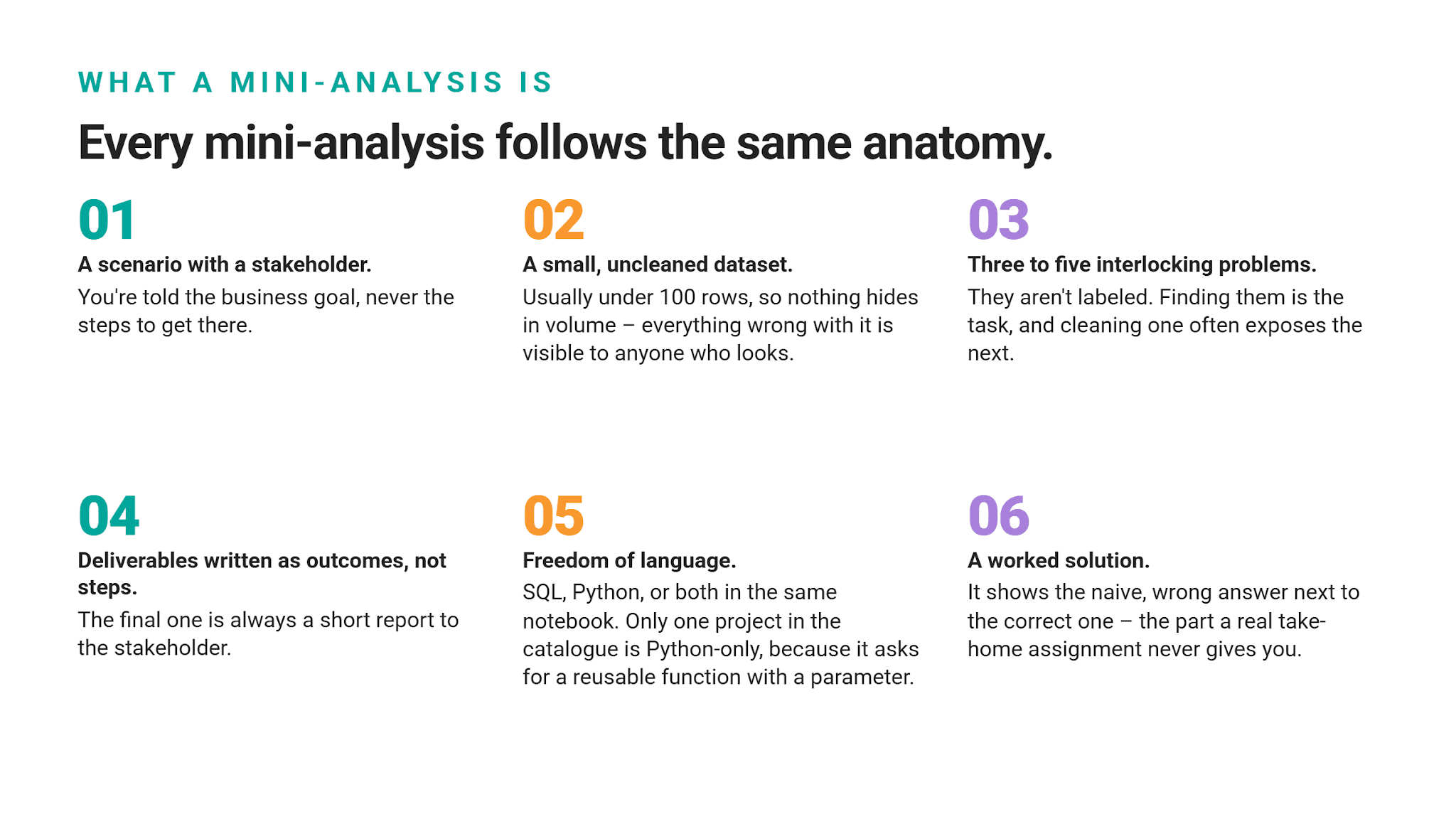
The defining feature is that the naive answer is almost always available, plausible, and wrong. A learner who doesn't inspect the data still gets a number — it just isn't the right one.
Why the Format Tests Judgment, Not Just Queries
A standard interview question tests whether you can write the query. It can't test whether you noticed a column loaded as text, or whether the metric you just averaged should have been weighted. Those decisions are most of the actual work of a data job.
Take the sharpest example in the current catalogue: one Dropbox plan charges $5 per subscriber and costs $9 to serve – it loses money on every customer. Divide fixed costs by that negative margin and breakeven comes out to −2,250 subscribers.
The obvious health check – does the plan have at least as many subscribers as its breakeven? – compares 2,000 with −2,250, answers yes, and reports the worst plan in the file, losing $17,000 a month, as healthy. No error. No warning.
Catching it means reading the sign of a number before trusting the arithmetic – and watching that check lie to you once teaches the habit permanently.
Two broader shifts are why we built the format around exactly this kind of moment.
- Data screening is moving toward live rounds where candidates analyze something and explain their choices out loud – the take-home is losing ground because nobody can tell who actually did the work.
- Writing the query is the part that's easiest for AI to automate, so what teams are hiring for is shifting toward the parts that stay human: deciding what a question means, noticing when data can't support an answer, and defending a choice.
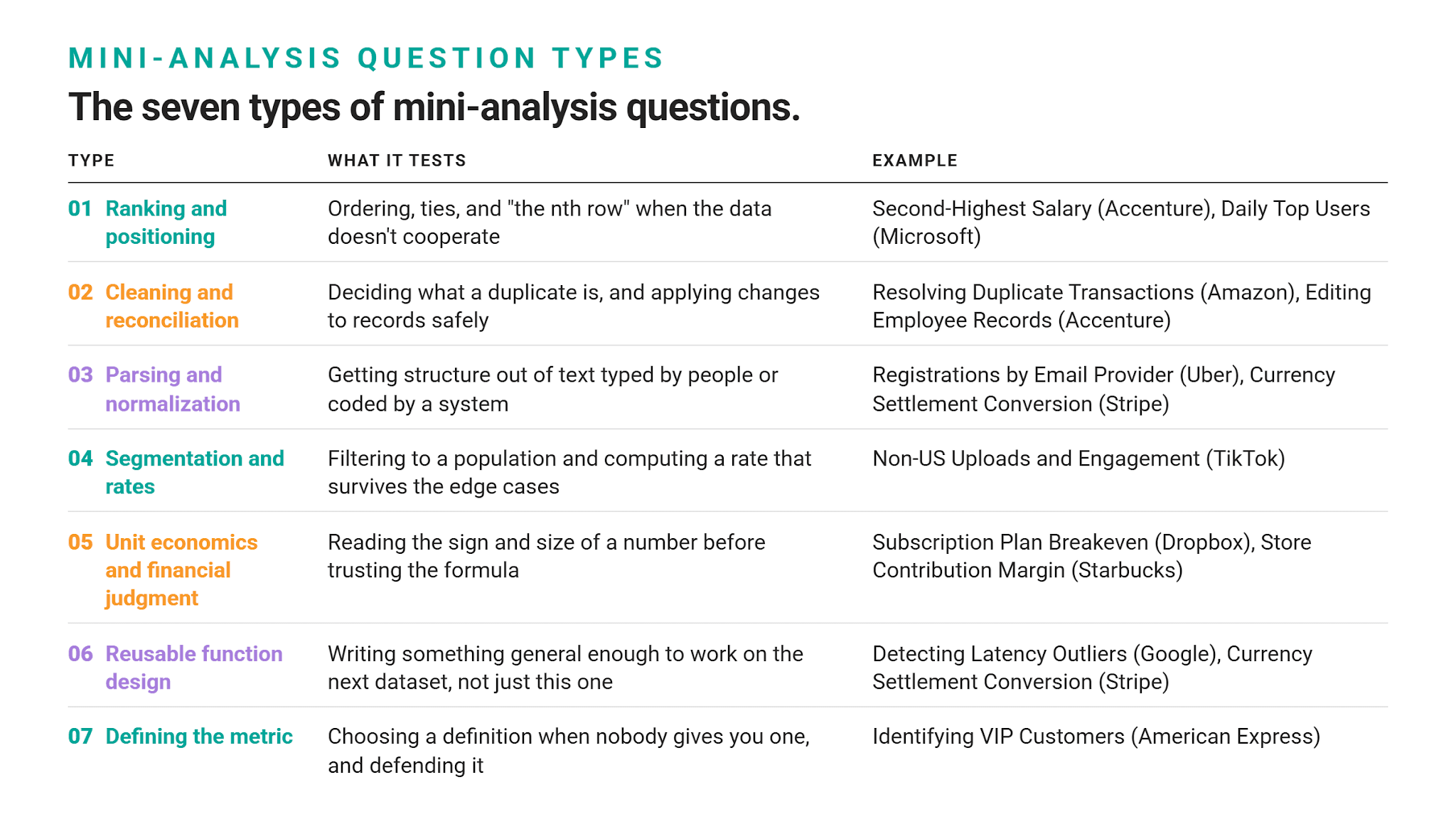
The Seven Types of Mini-Analysis Questions
Every mini-analysis in the catalogue falls into one of seven categories, each built around a different kind of judgment call:
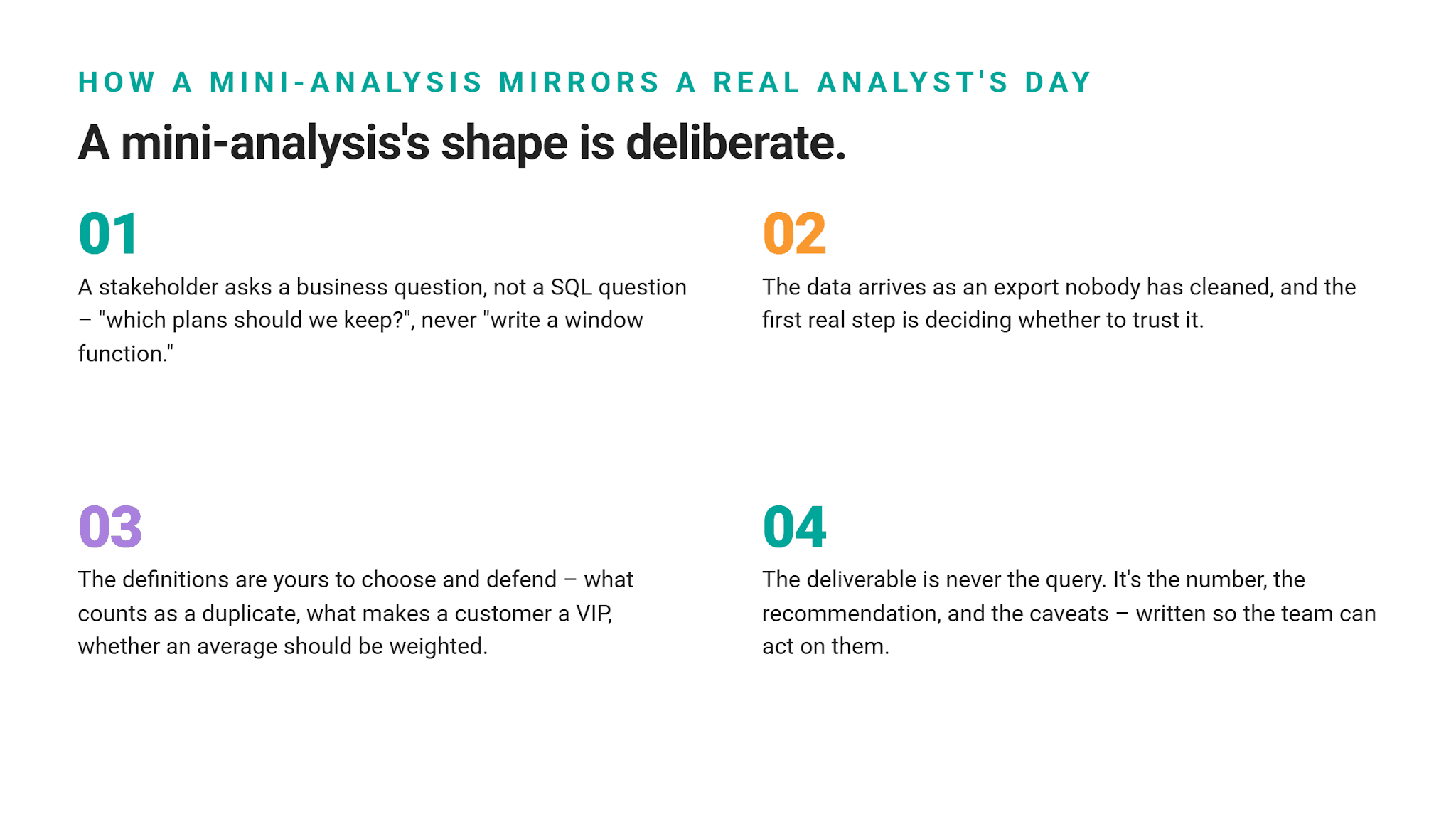
How a Mini-Analysis Mirrors a Real Analyst's Day
A mini-analysis's shape is deliberate. It mirrors the daily shape of analyst work, not an artificial test format:
Practice questions train you for interviews. Mini-analyses train you for the Tuesday after you're hired.
How Each Mini-Analysis Is Built
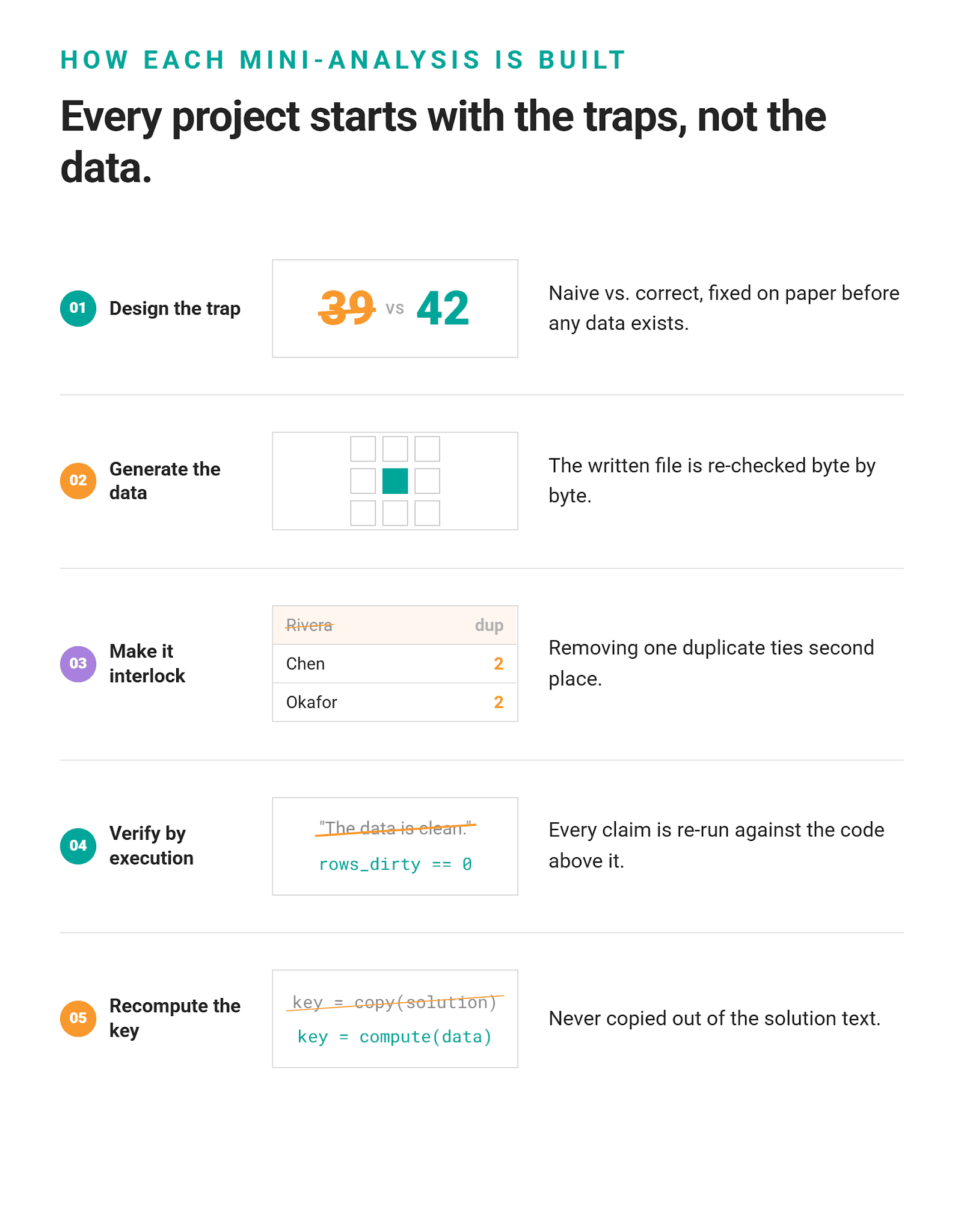
Each problem is designed on paper with two numbers attached – the naive result and the correct result. If they match, the problem has no teeth and gets replaced. Only after the traps are designed is the dataset generated, and the written file is re-checked to confirm every trap actually landed in the bytes.
The traps also interlock by design. In the headcount project, for example, removing three duplicate employee rows is what exposes a tie for second place – the cleaning step causes the next problem to surface.
Solutions are verified by execution, not just written and trusted. Every claim in the solution's prose is checked against the actual output of the code above it, because the most common defect in this format is a sentence describing clean data while the cell above it still shows the messy number.
Every value in the grading key – built for the automated scorer we're developing next – is recomputed directly from the data, never copied out of the solution text. Until that scorer ships, the worked solution is the feedback: you compare your numbers and your reasoning against it.
Try It Yourself
There are 15 mini-analyses at launch, spanning 13 companies and all seven question types. Two are free: Second-Highest Salary – the familiar question with the traps described above – and Subscription Plan Breakeven, the one with the health check that passed the worst plan in the file as healthy.
Start with the salary question. You know the query. See if you get 198,000.
Frequently Asked Questions
How long does one mini-analysis take?
About a sitting. Datasets are small, and each project has two to four deliverables.
Is it graded automatically?
Not yet. The worked solution is the feedback for now. Every project ships with a structured grading key built for the automated scorer that's coming next.
Do I need to know Python?
No – except for one project in the catalogue that asks for a reusable function with a parameter, which SQL alone can't express. Every other mini-analysis can be solved in SQL, Python, or a mix of both.
How is this different from a Kaggle notebook or a capstone project?
Scope and intent. A capstone is open-ended and can take weeks. A mini-analysis is a bounded task with specific deliverables, engineered problems, and a solution to compare your work against.
What makes it interview prep rather than a course?
Nothing is taught up front. The task page never says what's wrong with the data — that's the same position you're in during a real take-home assignment.
Share