The 11 Best Data Science Platforms (Compared for Beginners, Professionals & Interview Prep)

 Written by:
Tihomir Babic
We compared data science platforms and picked 11 best for data scientists. Beginners, professionals, interview preppers? You’ll find your platform here.
Picking a data science platform in 2026 feels like doing anything in 2026: first, they overwhelm you with choice; then, they tell you what you actually need; finally, they promise you they alone do exactly the thing they told you that you need. In the end, you click “Subscribe” at random, hoping you chose the best platform.
Most likely, you didn’t. Why? Because there’s no such thing as a universally “best platform”, despite everyone claiming they’re exactly that.
What’s best depends on your needs, not on the needs of those trying to sell you something. A beginner still figuring out what a DataFrame is needs something completely different from an experienced data scientist preparing for the AI engineer job interview next week.
That is why I compared 11 platforms (+3 as a bonus) across pricing, difficulty level, and what each one is actually good for, so you can find the one that matches your goal instead of chasing whatever's trending.
Quick Comparison Table
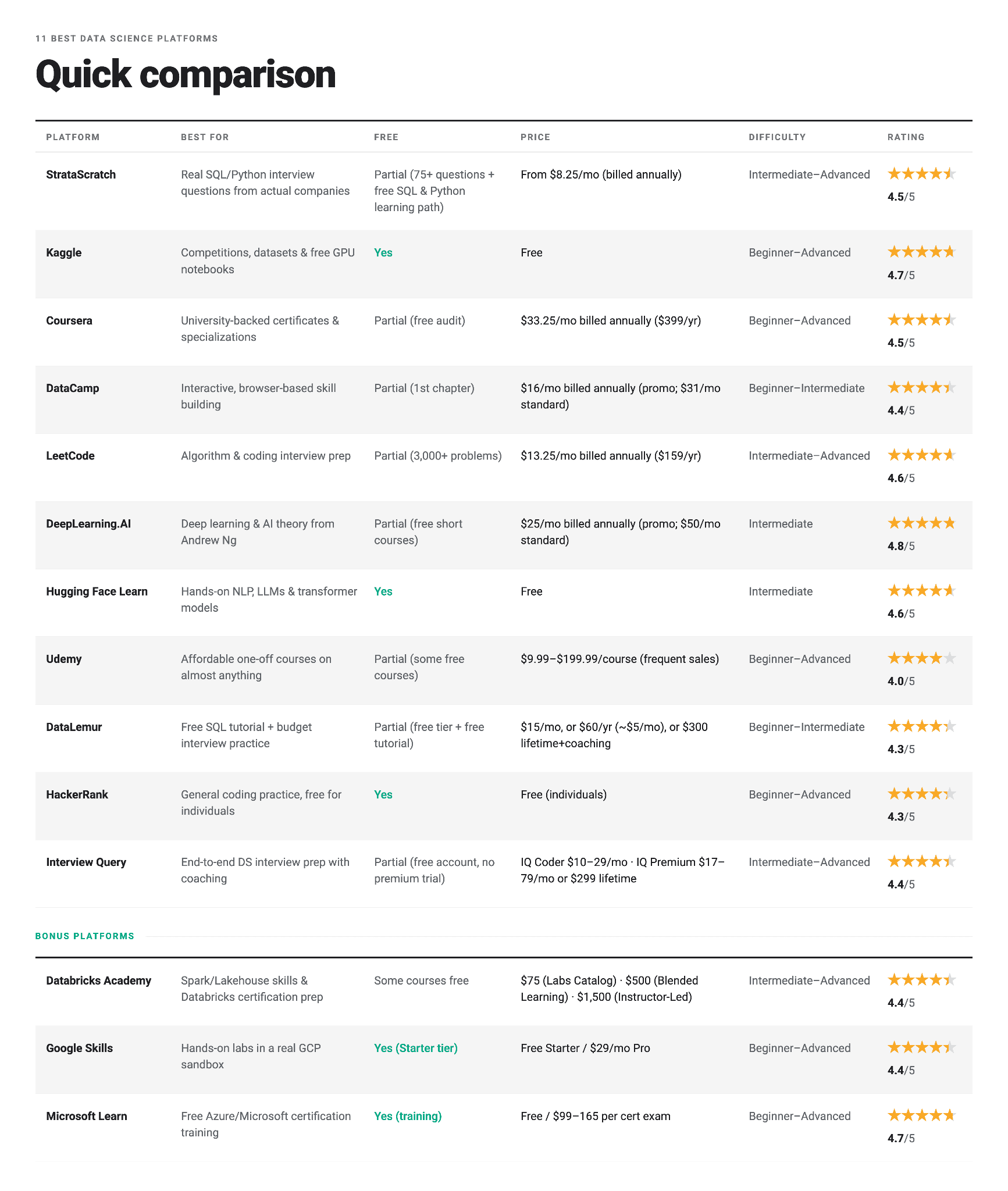
Here’s a quick overview of all the platforms.
We’ll discuss each one in detail in a moment. But first we want to talk about the criteria we used to choose the platforms.
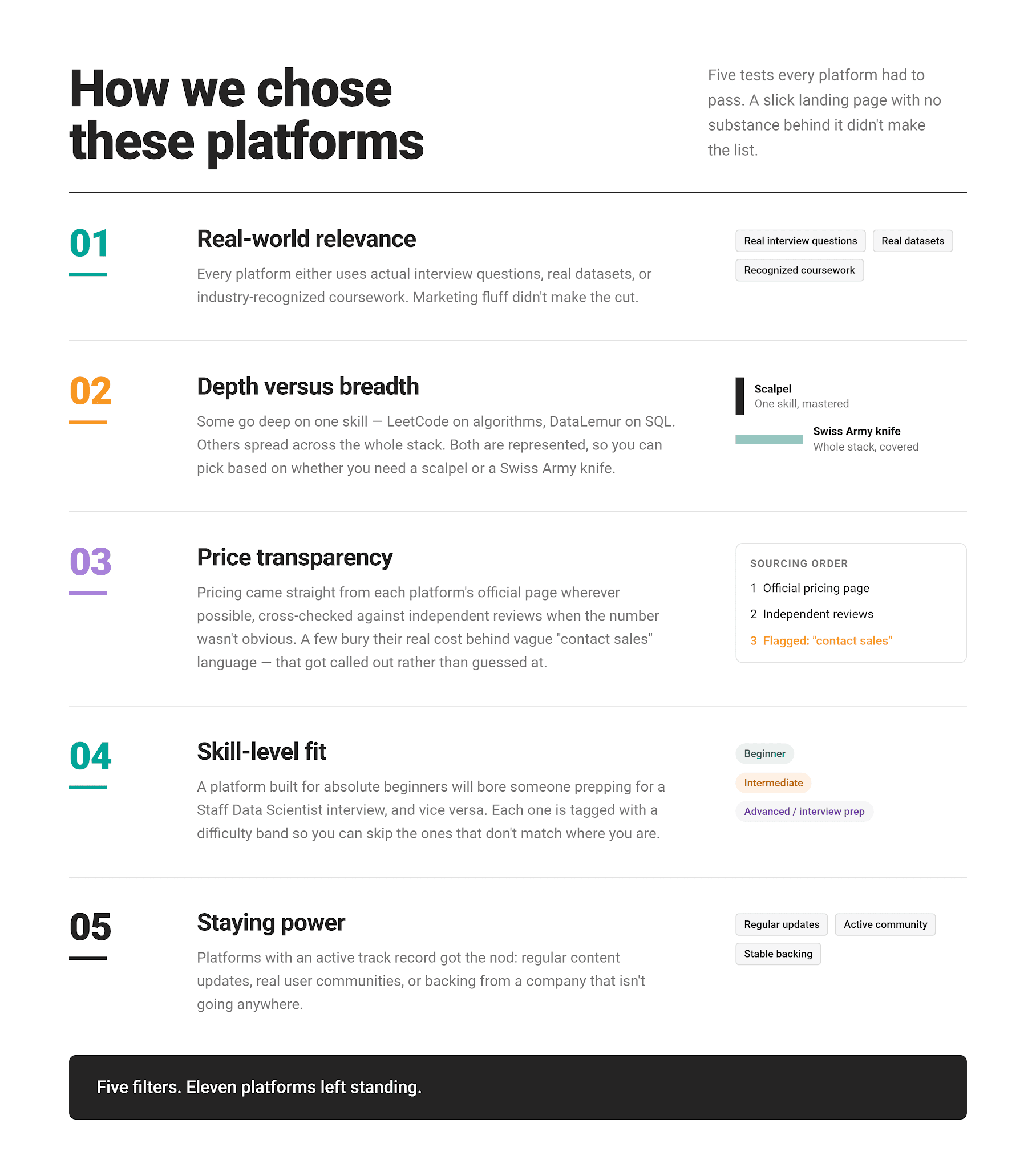
How We Chose These Platforms
We didn’t pick those 14 platforms randomly out of hundreds. We built the shortlist around a handful of criteria that actually predict whether a platform will get you where you're trying to go.
I drew from my own experience of interviewing as a data scientist and sitting on the other side as an interviewer.
How We Rated Each Platform
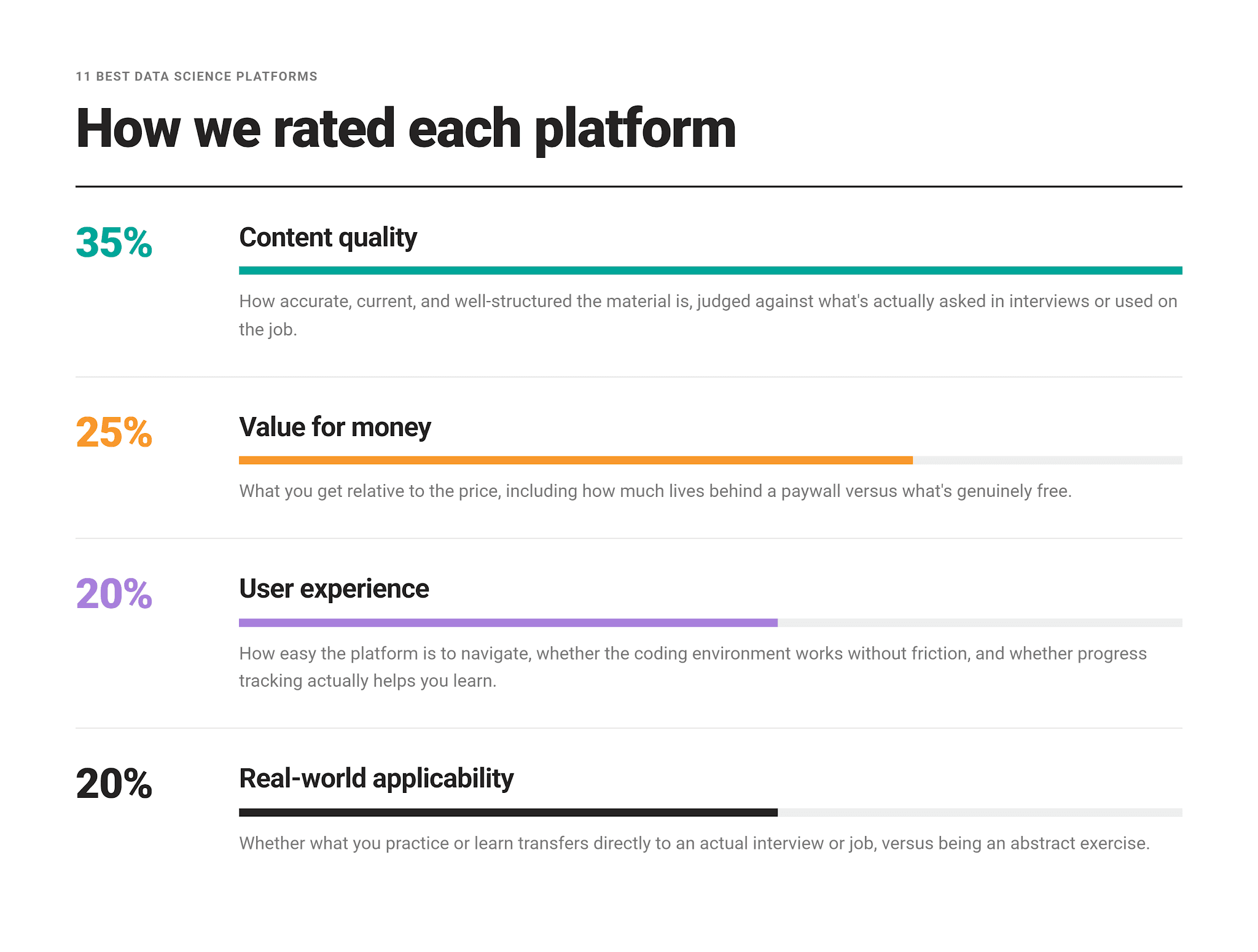
The rating we used isn’t taken from a review aggregator. It’s our own editorial rating, built from the weighted factors.
Best Data Science Platforms
And now, each platform’s details to help you decide which one’s for you.
1. StrataScratch
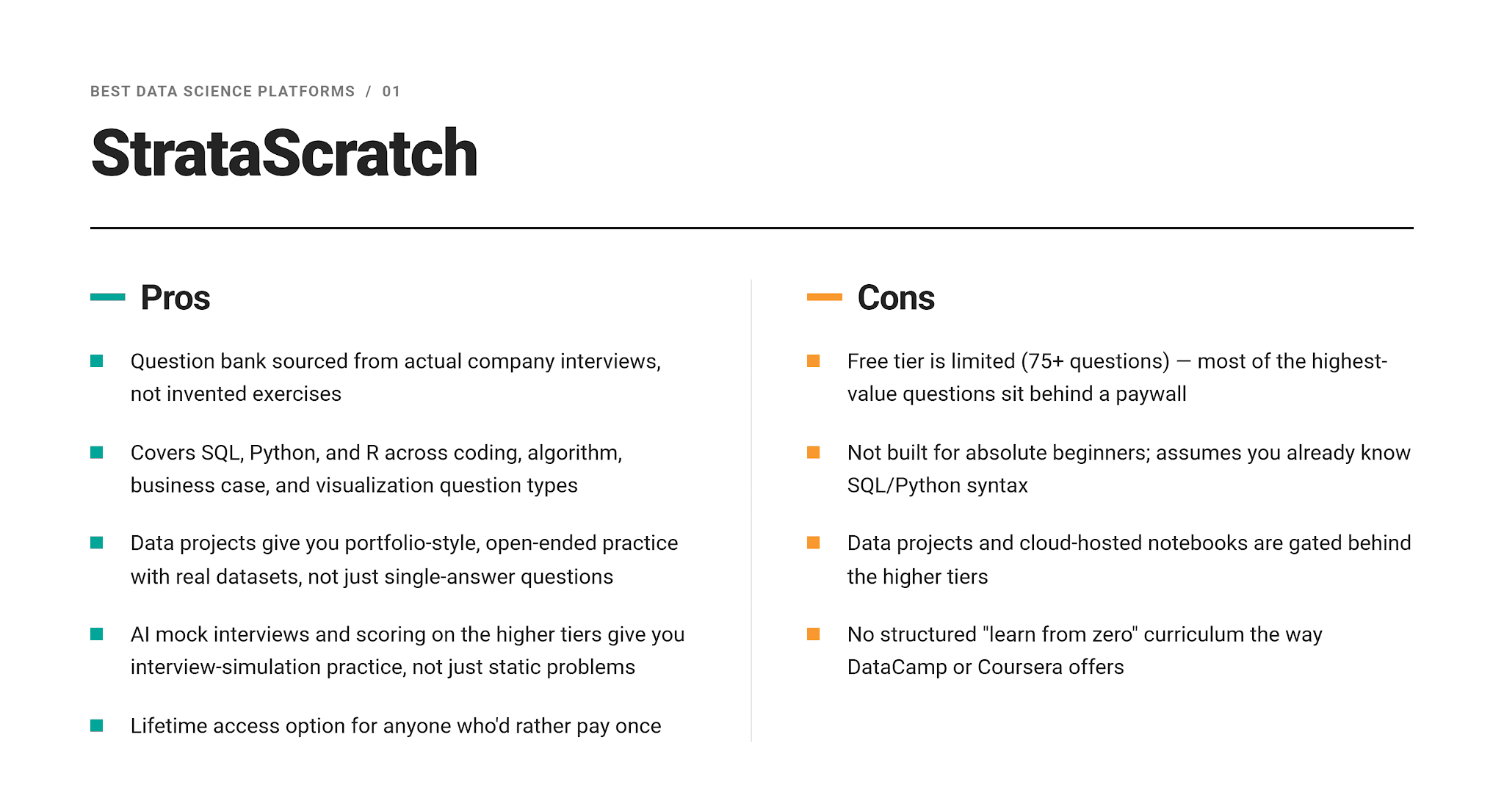
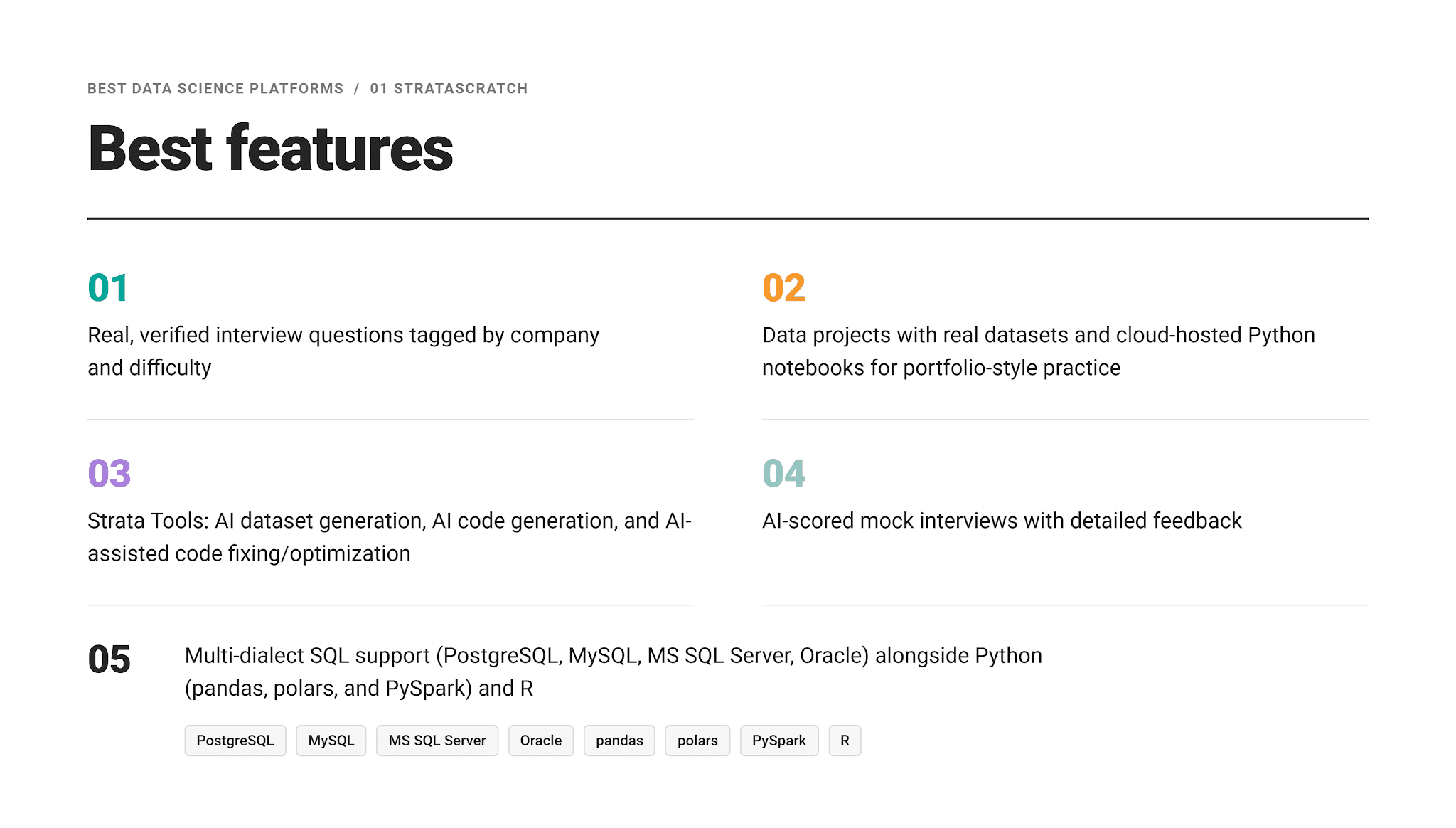
StrataScratch is an interview-prep platform built around real interview questions. Every question comes from an actual hiring process at a real company, rather than a generic textbook exercise.
Real-world sourcing is what sets it apart from most course-based platforms. Learning is not abstract: you’re solving exact problems the companies use to separate good candidates from the rest.
Besides the interview questions, there are also Strata Projects, a collection of actual data projects/take home assignments. They contain real datasets paired with open-ended prompts you work through in cloud-hosted Python notebooks, closer to what an actual data science job looks like than a single isolated coding question.
On top of that, Strata Tools brings AI directly into your workflow – AI dataset generation, AI code generation, and an AI assistant that fixes and optimizes your code – which can also be purchased as standalone products if you don't want a full subscription.
Pros & Cons
Pricing
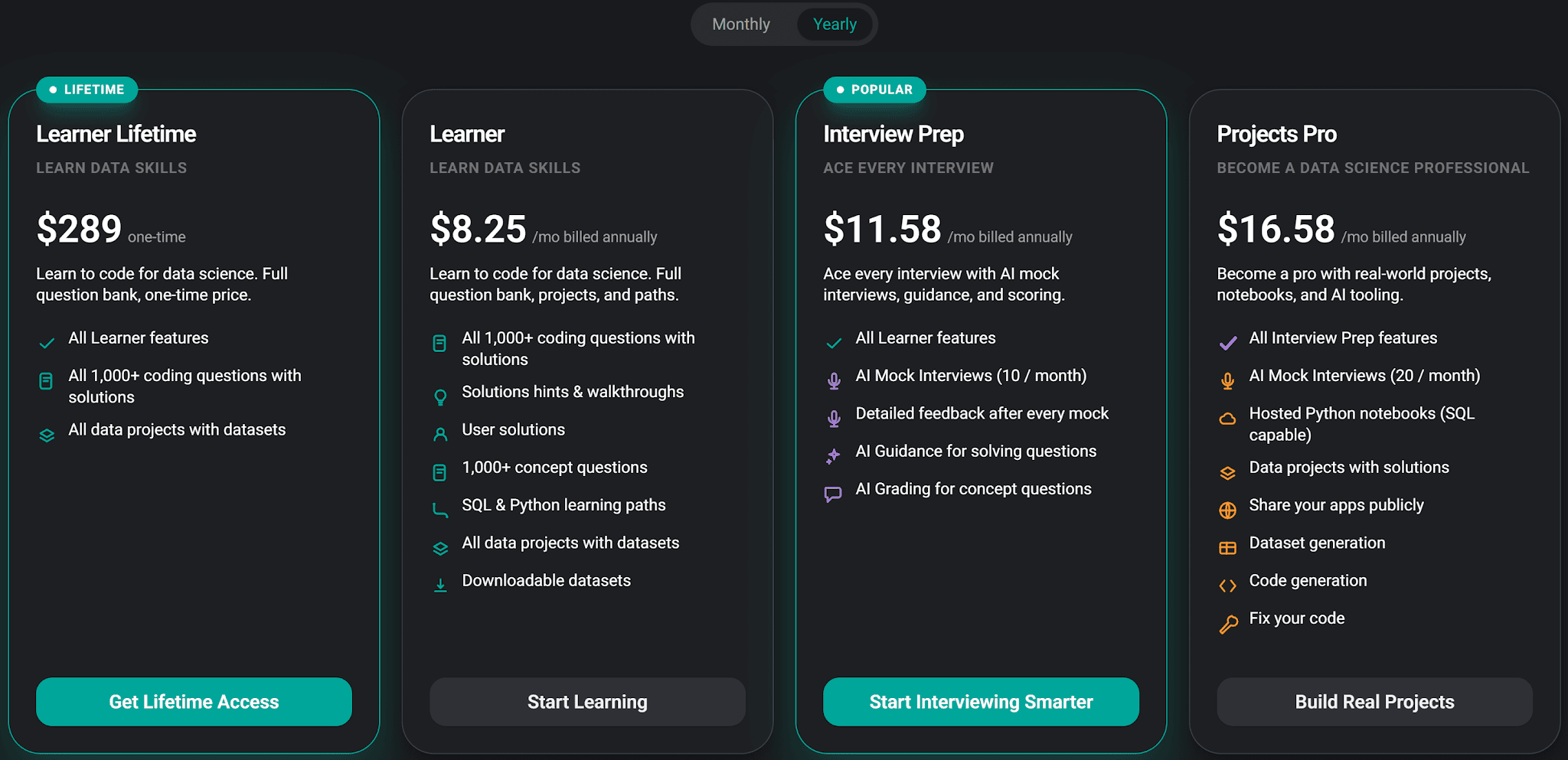
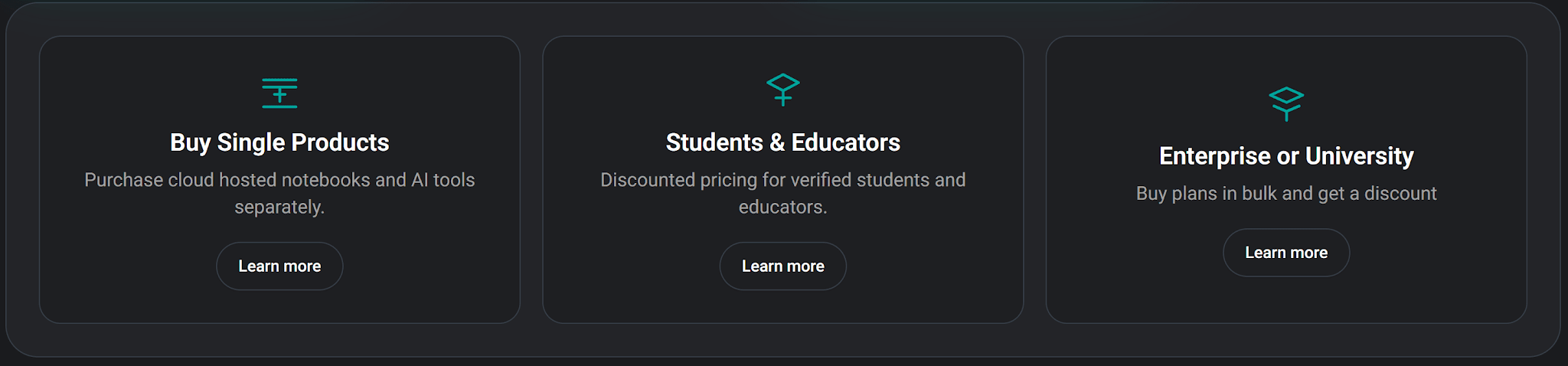
Free tier (75+ questions), then a Learner plan from $8.25/mo billed annually, an Interview Prep tier at $11.58/mo with AI mock interviews and scoring, and a Projects Pro tier at $16.58/mo that adds cloud-hosted Python notebooks, downloadable datasets, and Strata Tools (AI dataset generation, AI code generation, code fixing). A Learner Lifetime option runs $289 one-time. Cloud-hosted notebooks and AI tools are also available as standalone single-product purchases outside a full subscription, with discounted pricing for students and educators.
Best Features
Who Should Use It?
Anyone actively interviewing for data roles who already has SQL or Python fundamentals down and wants targeted, realistic practice (including project-based work sped up by AI tooling) rather than another beginner course.
Who Shouldn’t Use it?
Complete beginners. If you don’t know basic SQL, Python, or R syntax, you’ll be better off with a foundational course first, then coming back. However, you can also take StrataScratch's free SQL and Python learning path.
Difficulty & Rating

2. Kaggle
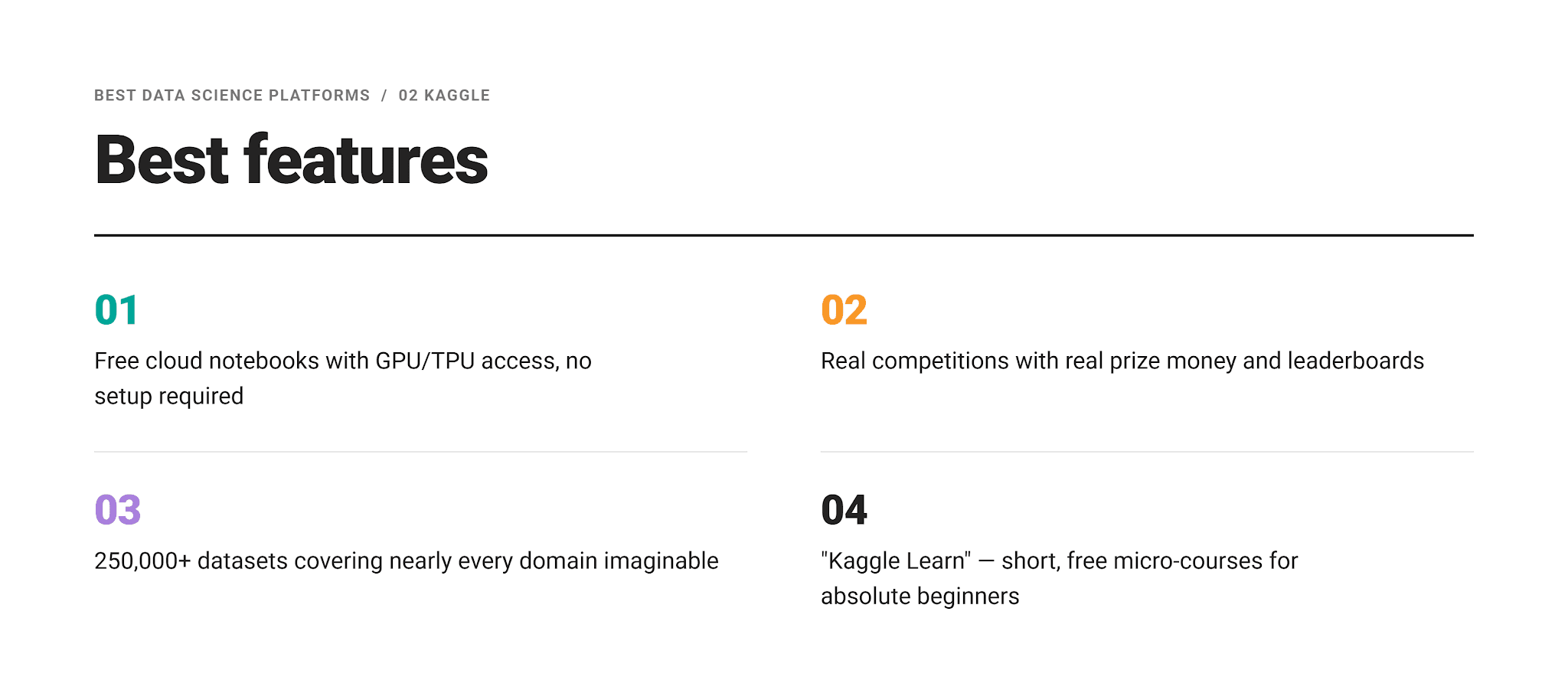
Kaggle is Google's data science and machine learning community. It’s built around competitions, datasets, and free cloud notebooks.
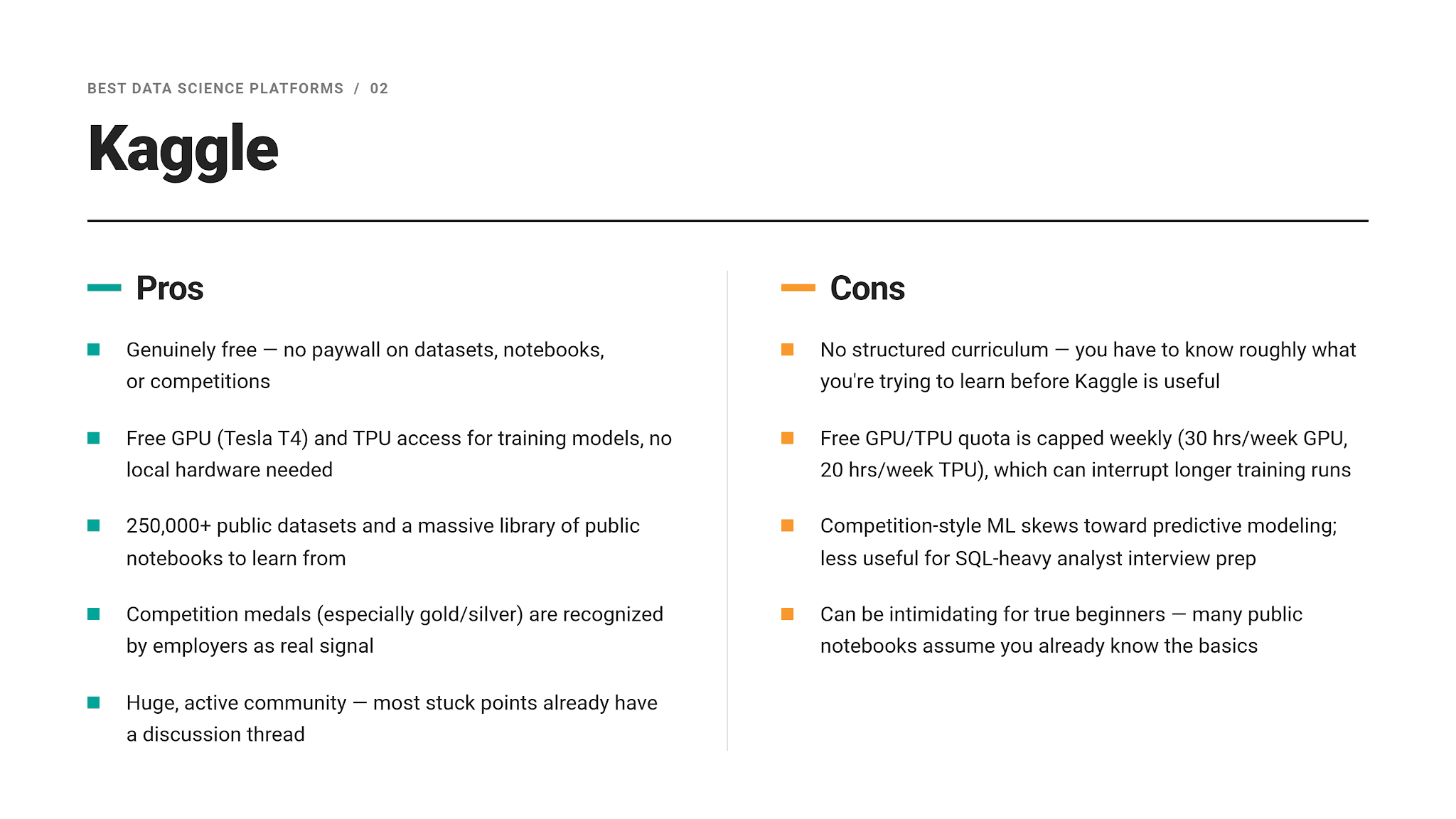
What makes Kaggle different from a course platform is that nothing here is scripted for you. You pick a competition or dataset, and you figure out the approach yourself – with the entire notebook history of everyone else who's tackled the same problem sitting right there for you to learn from.
Pros & Cons
Pricing
Completely free for individual use. The free plan includes full access to datasets, notebooks, competitions, and community forums.
Costs only come into play if you outgrow Kaggle’s compute limits. Then, you’ll have to connect a paid Google Cloud Platform account, but that’s technically a GCP cost, not a Kaggle one.
Best Features
Who Should Use It?
Anyone who likes learning by doing, needs free compute to practice machine learning modeling on real datasets, or wants competition experience for their CV/portfolio.
Difficulty & Rating

3. Coursera
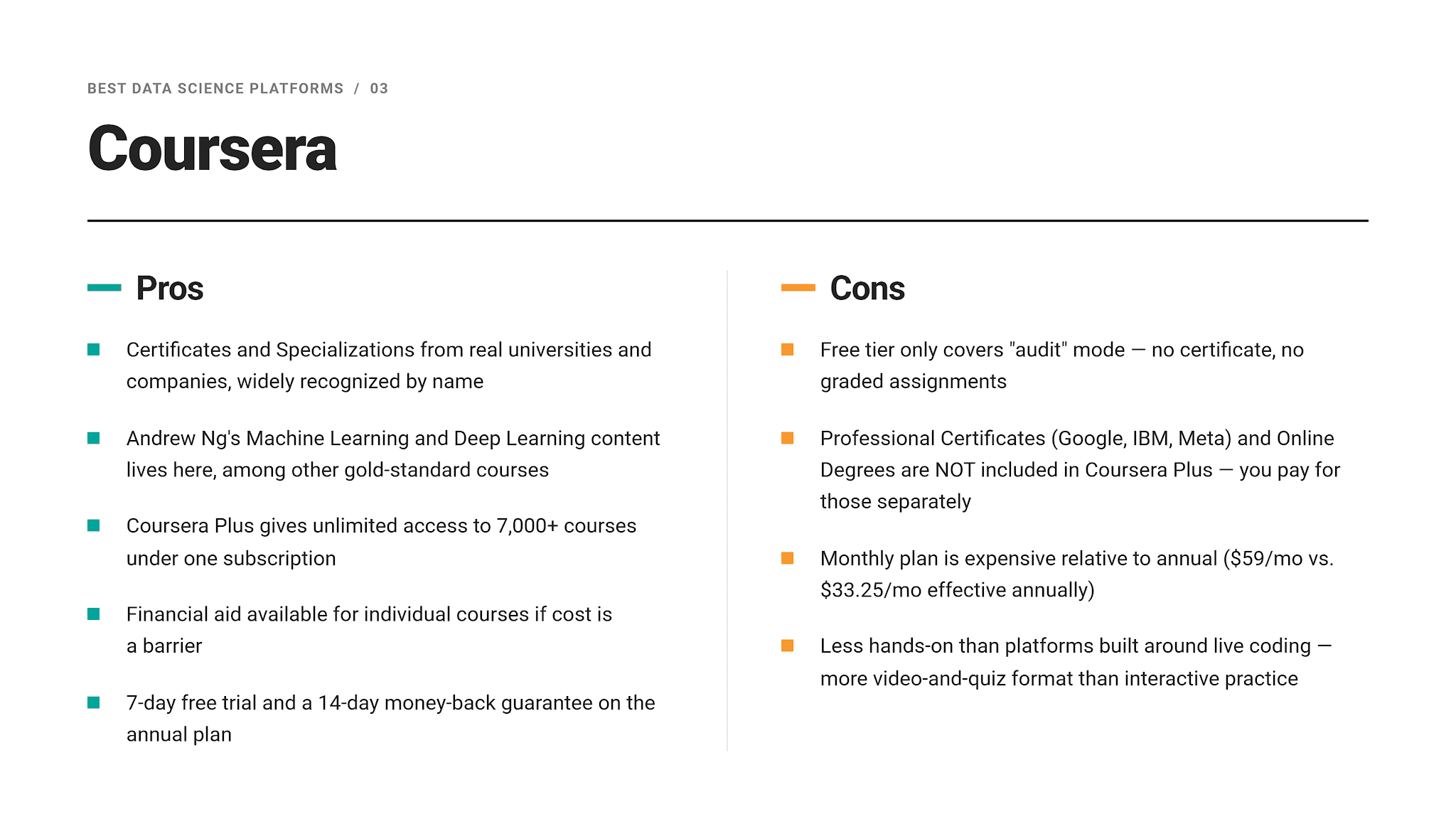
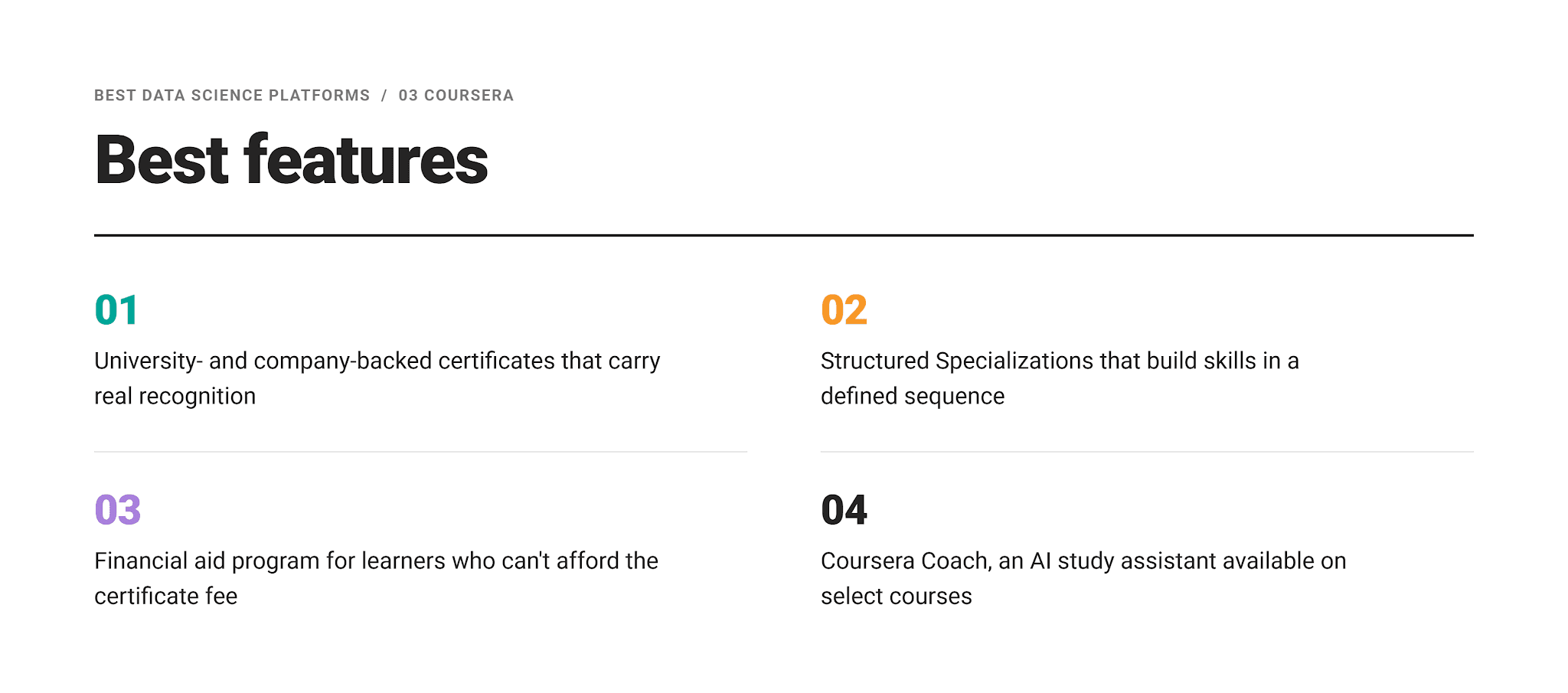
Coursera offers structured courses, Specializations, and full online degrees in partnership with companies (Google, IBM, Meta) and universities (Stanford, Yale, Imperial College).
It's the high-credibility platform where you can earn recognized certificates that can improve your chances of getting a job. Some data science Specializations, such as Andre Ng’s Machine Learning Specialization, have become industry-standard starting points.
The platform is oriented towards structured learning over several weeks or months.
Pros & Cons
Pricing
There’s a 7-day free trial. For Coursera Plus, you have to pay $59/month or $399/year ($33.25/month effective). On the annual plan, there’s a 14-day money-back guarantee.
That doesn’t necessarily mean every course is covered in that. Individual courses and Specializations outside the annual plan are typically priced at $49- $79/month until completion. Coursera frequently runs promotions that discount the annual plan.
Best Features
Who Should Use It?
Those switching careers or jobs who want a recognizable credential and can commit to continuous learning over weeks or months.
Who Shouldn’t Use It?
Don’t use it if you want fast learning and interview practice or if you’re unwilling to pay for the certificates on top of the Plus subscription.
Difficulty & Rating

4. DataCamp
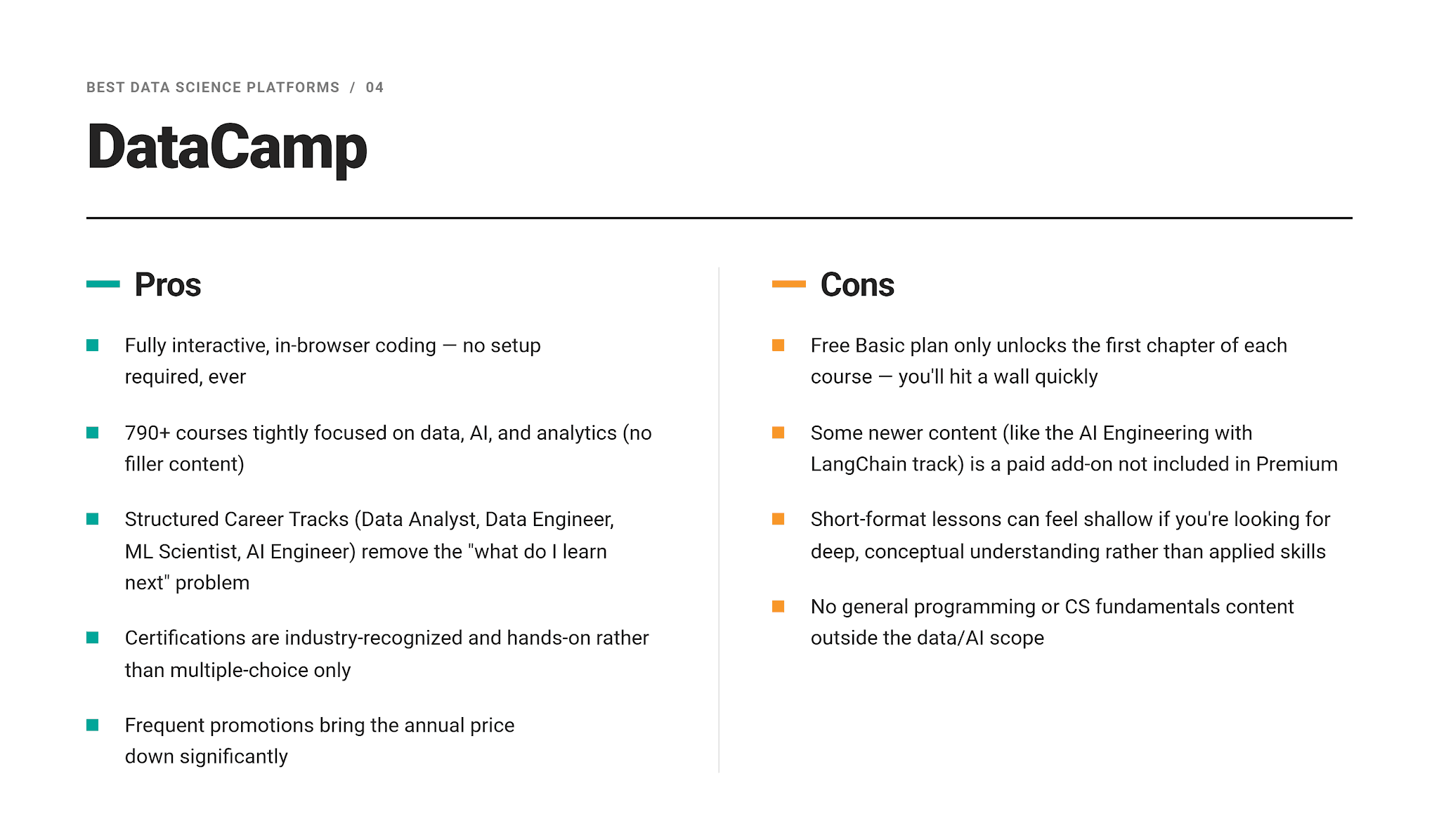
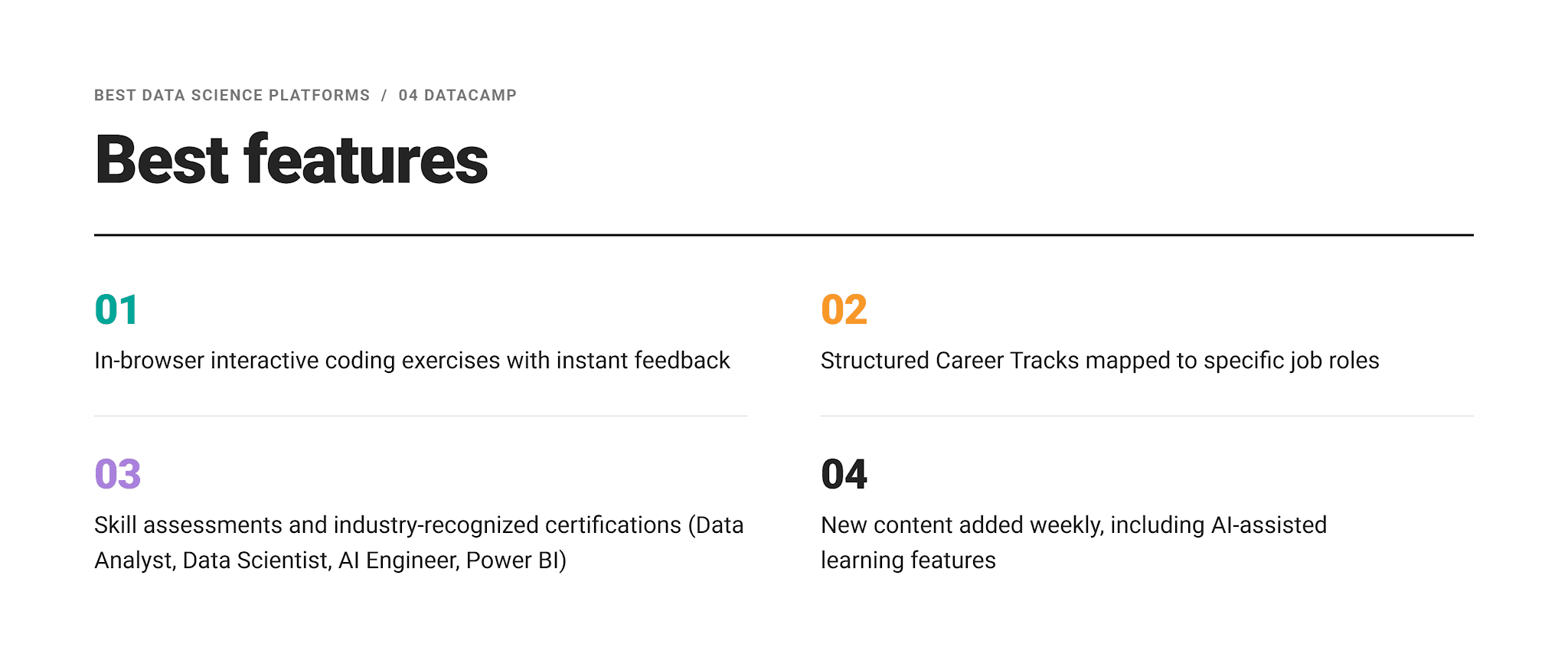
DataCamp is built only for learning data and AI skills. Every course runs in-browser with short video segments broken up by interactive coding exercises, so you're writing real code within minutes of starting rather than watching a long lecture before touching a keyboard.
The platform's narrow focus can be an advantage or deterrent, depending on your needs. If what you’re interested in is Python, R, SQL, Power BI, and AI, then you get hands-on coverage split into smaller bits that you can easily watch whenever it suits, even in a break or when commuting.
Pros & Cons
Pricing
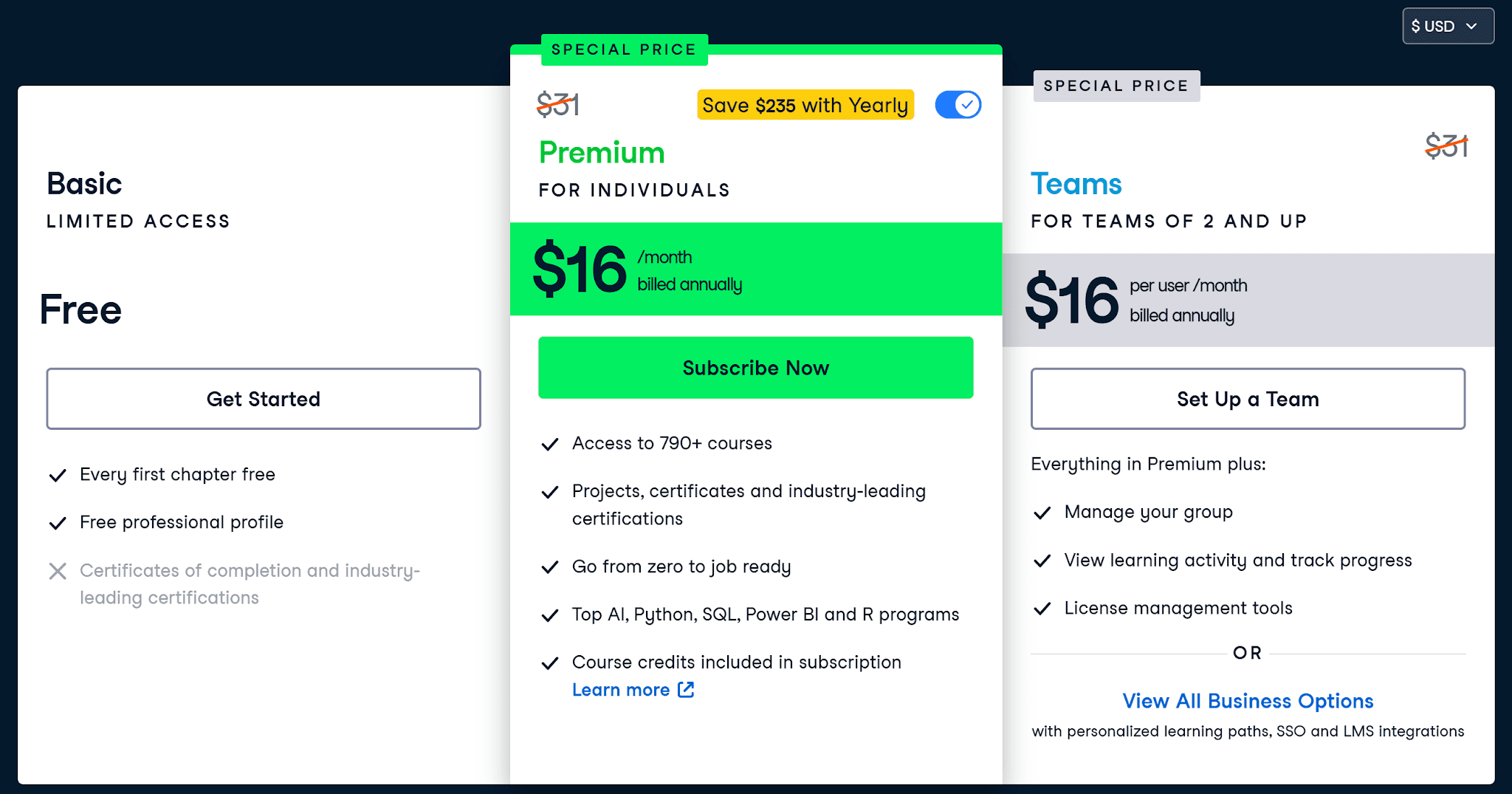
The Basic plan is free and gives you limited access, meaning you can access only the first chapter of each course. The Premium plan is $16/month (currently, down from $31), billed annually. The Teams plan (2+ members) is, as well, $16/month billed annually, which also seems to be a current special offer.
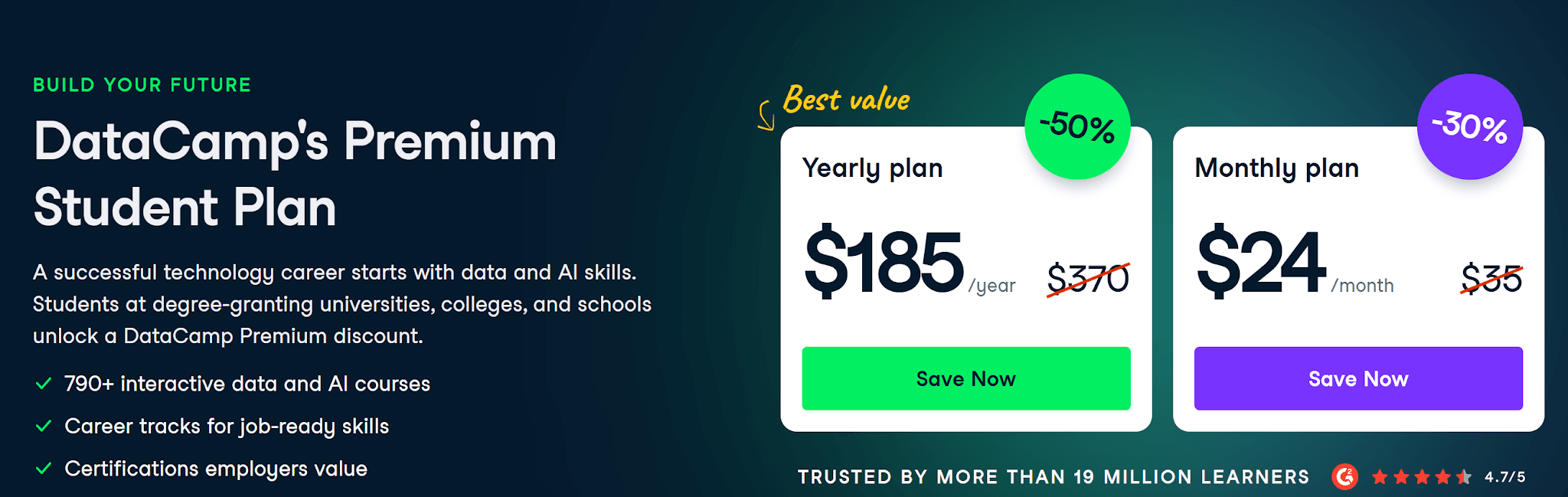
All these plans are for individuals. If you’re a student, 50%-off Premium Student plans are available, yearly ($185/year) or monthly ($24/month).
Best Features
Who Should Use It?
The platform targets beginners and intermediate learners who want guided, hands-on courses. The course structure is especially well suited for those who can’t dedicate too much uninterrupted time to long learning sessions.
Who Shouldn’t Use It?
Advanced learners. You won’t get deep conceptual or research-level knowledge.
Difficulty & Rating

5. LeetCode
LeetCode is the default coding interview preparation for software engineers.
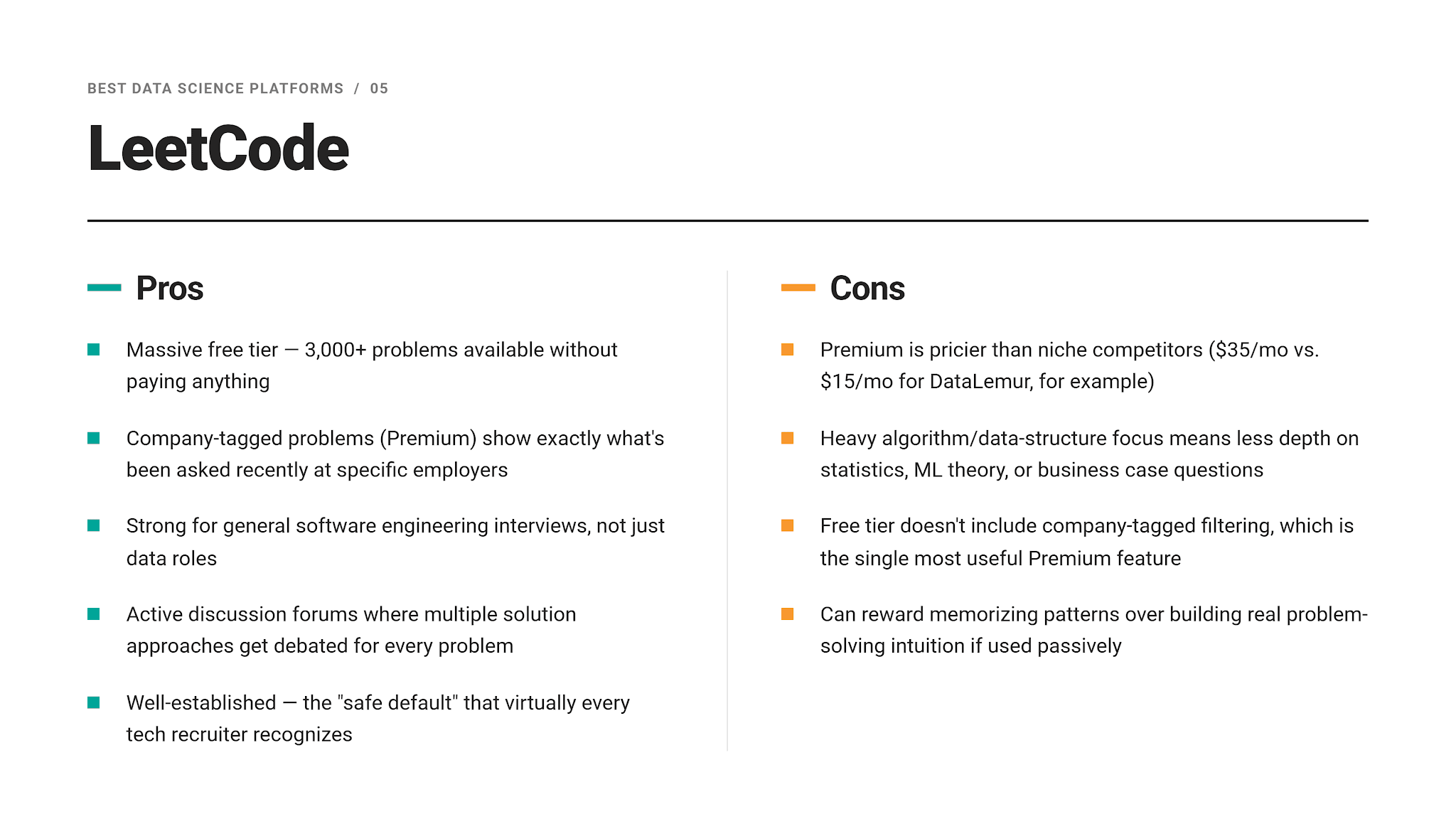
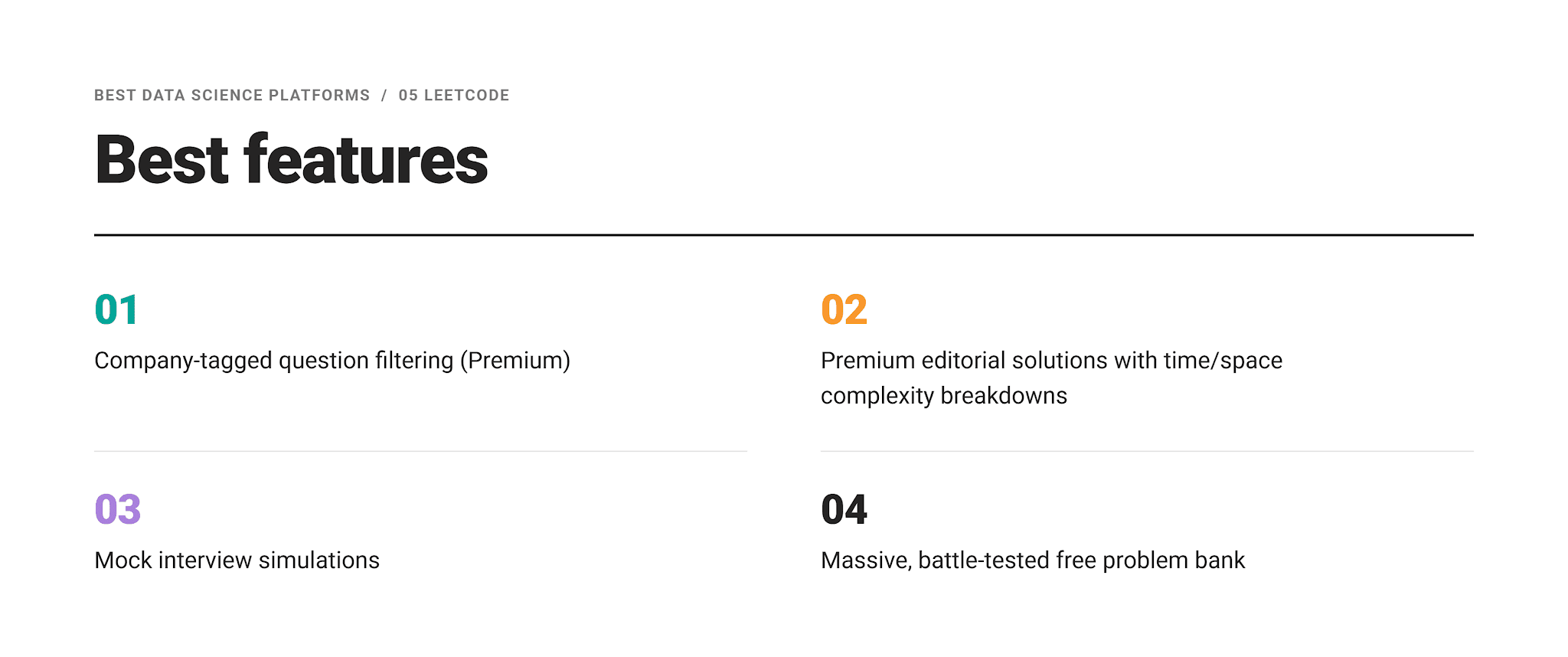
The platform’s core product is a massive bank of algorithm and data structures problems that are relevant to data scientists and ML engineers, too.
The questions are from actual job interviews, so if you’re looking for a specific problem and a specific company, the chance is you’ll find that here.
You can solve questions in all relevant programming languages (more than 10), including Python, Java, C++, Rust, Ruby, and Scala.
There’s also a smaller bank of database questions that you solve in several SQL dialects (and Python), SQL is not the platform's primary draw the way it is on other platforms.
Pros & Cons
Pricing
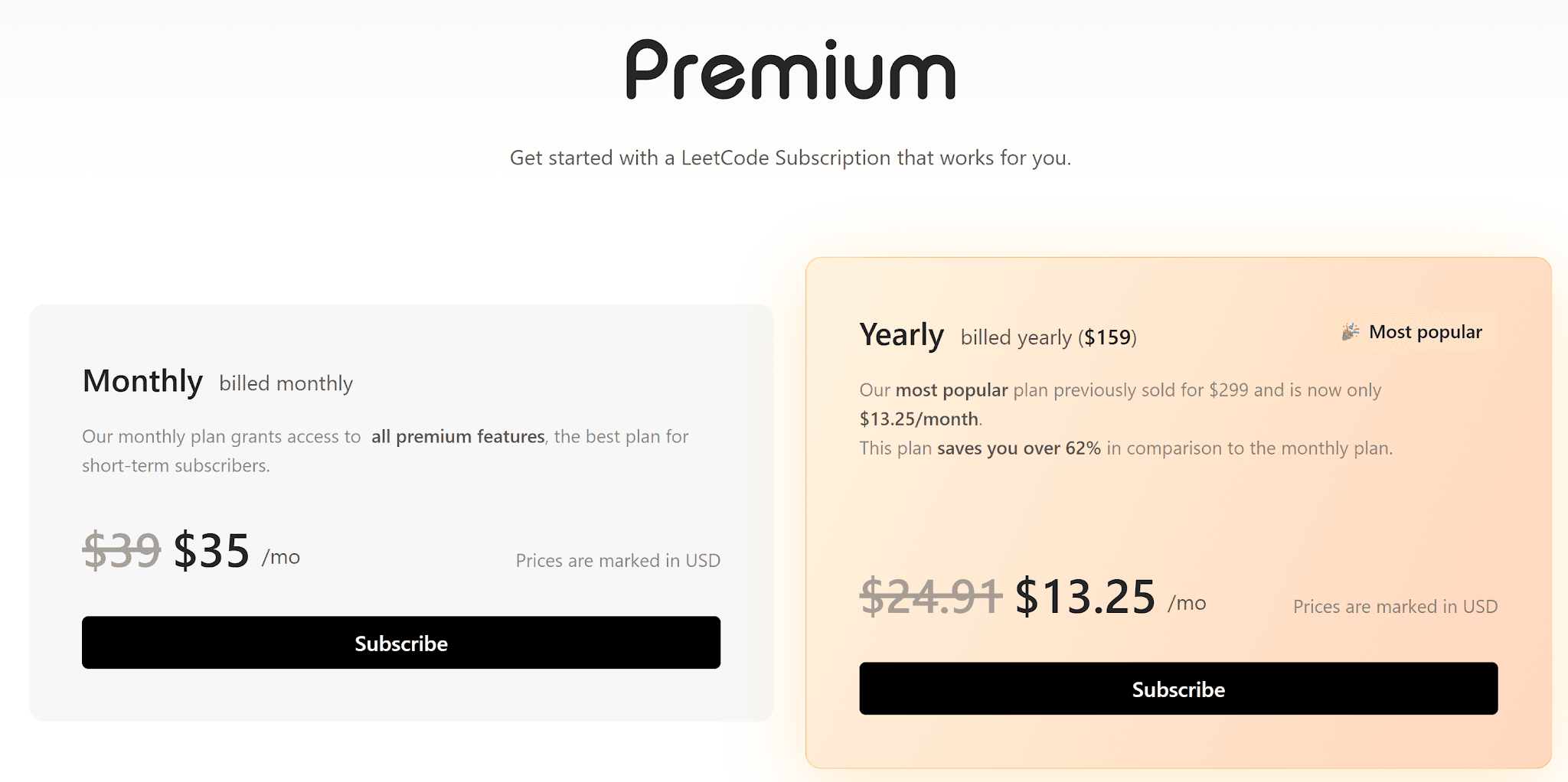
The Free tier allows you to access 3,000+ interview questions. The monthly Premium Subscription costs $35/month (previously $39), while the yearly subscription is $159/year (previously $199), billed yearly (effectively $13.25/month).
Education/school-email discounts are sometimes available.
Best Features
Who Should Use It?
Anyone preparing for coding-heavy technical interviews, especially at companies that emphasize algorithmic screens alongside SQL and statistics rounds.
Who Shouldn’t Use It?
LeetCode is not the best choice if you’re preparing for the SQL- and analytics-heavy interviews.
Difficulty & Rating

6. DeepLearning.AI
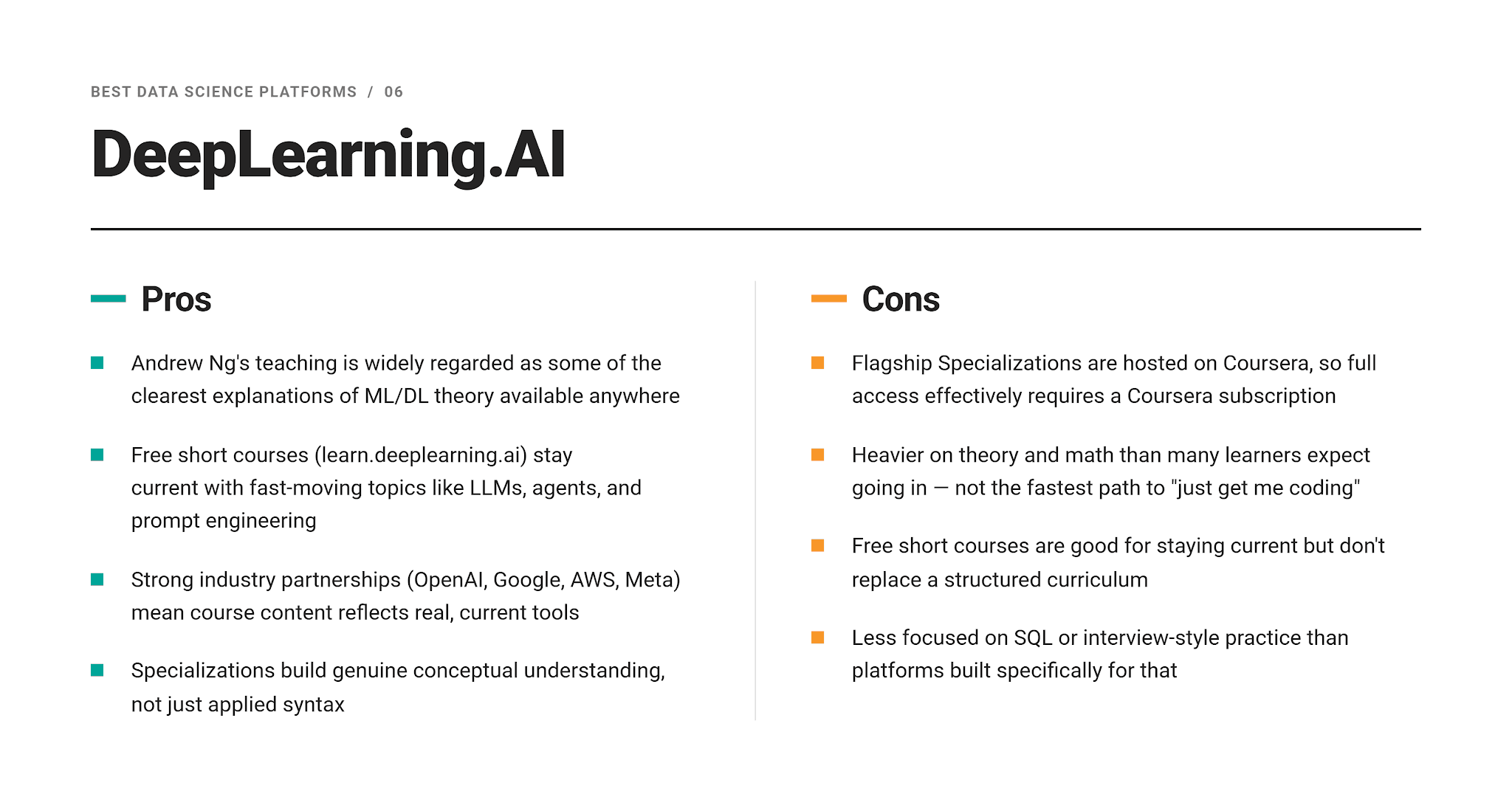
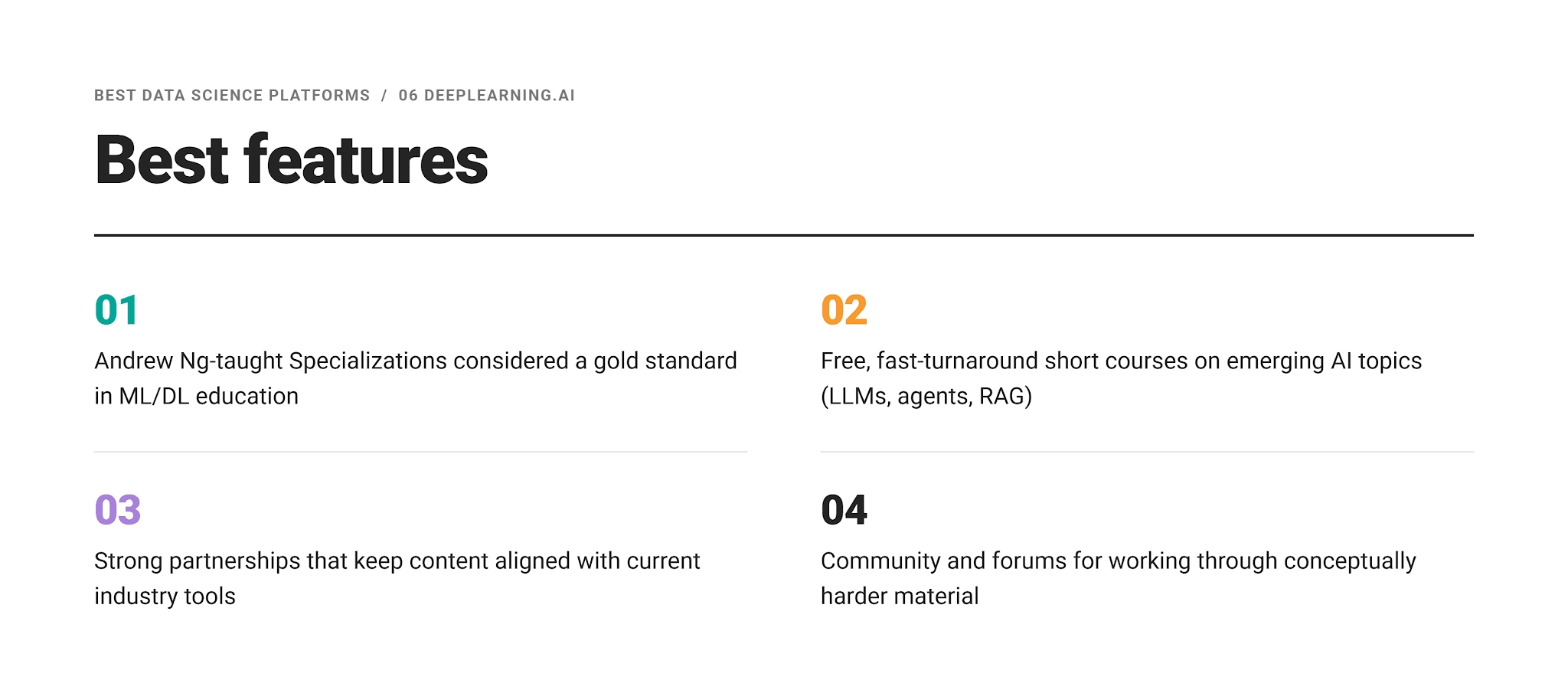
DeepLearning.AI is Andrew Ng’s education platform. It’s built around some of the most widely-taken AI and machine learning courses on the internet.
Beyond the paid Specializations, DeepLearning.AI also runs learn.deeplearning.ai, a library of free, short courses (often 1-2 hours) built in partnership with companies like OpenAI, Google, and AWS, covering practical topics like prompt engineering, LangChain, and building with LLMs.
The platform stands out with its combination of rigorous theory and practical AI skills.
Pros & Cons
Pricing
With the Free plan, you can access all courses’ videos. Currently, there’s 50% off the yearly Pro subscription ($300/year; $25/month). If you want the monthly option, it’s $30/month; a 40% discount.
With that subscription, you get access to hands-on labs, exclusive courses from Andrew Ng, personalized feedback on your work, and the ability to build a portfolio and earn a certificate.

Best Features
Who Should Use It?
Anyone interested in understanding the theory behind machine learning and deep learning and applying it.
Also, anyone who wants to stay abreast of the latest developments in those fields can take their free short courses.
Who Shouldn’t Use It?
Anyone looking for SQL-focused interview prep or fast, applied coding practice.
Difficulty & Rating

7. Hugging Face Learn
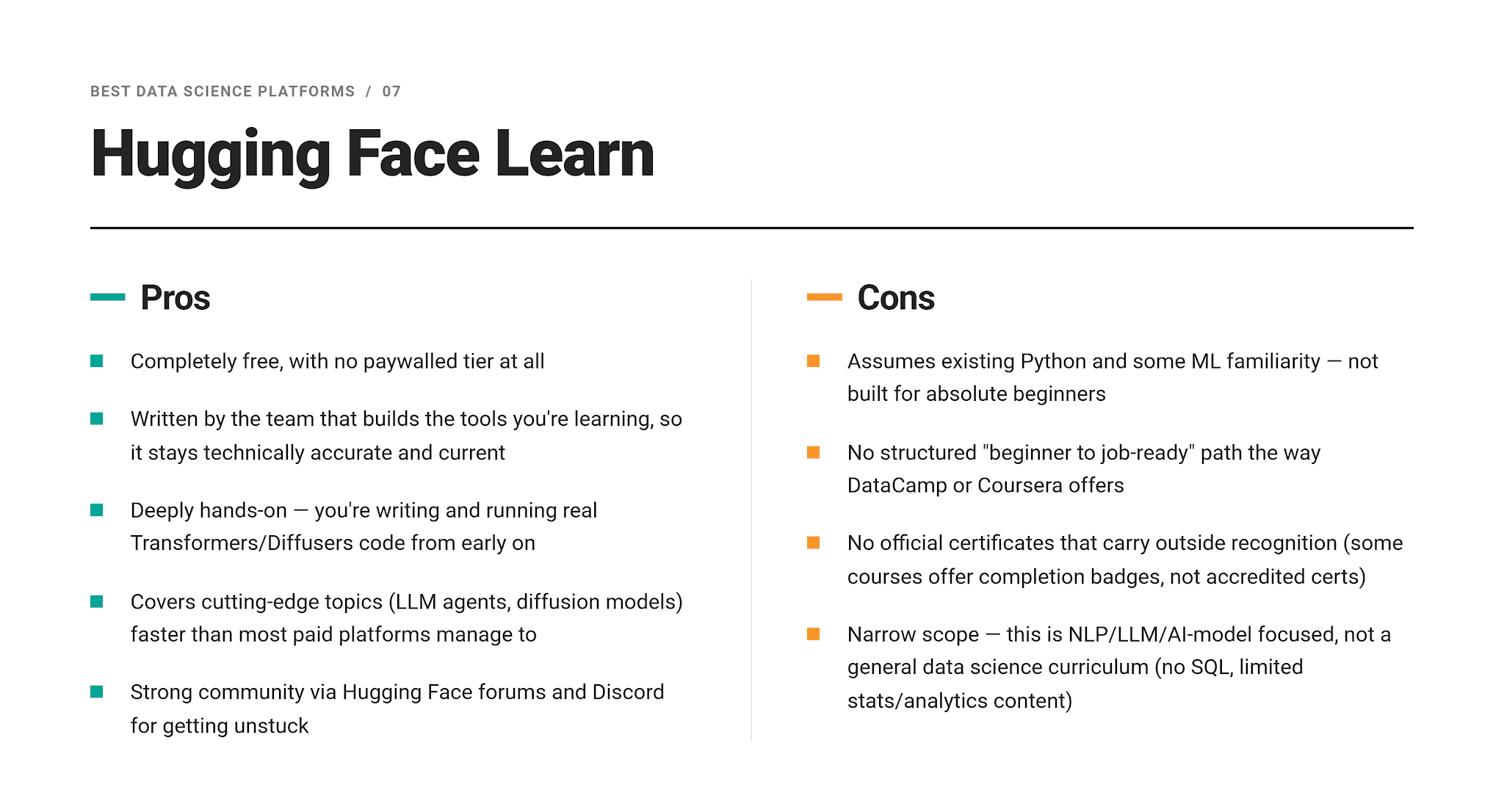
Hugging Face Learn is a free educational platform of Hugging Face, the company behind the Transformers library and the model hub that's become the default home for open-source AI models.
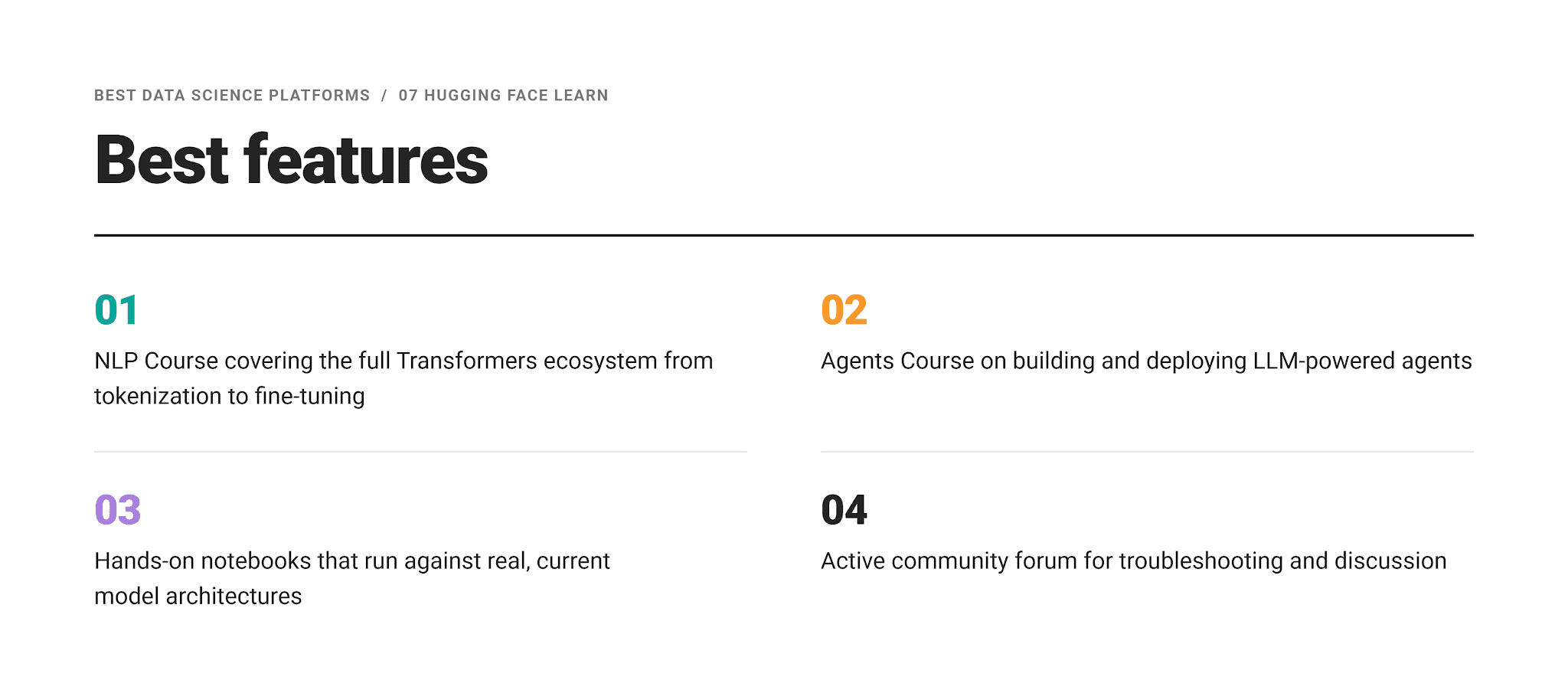
The courses are written by the same engineers building the actual tool. That way you’ll learn about LLMs, context engineering, robotics, agents, deep RL, computer vision, audio data, diffusion, and ML for 3D directly from the source.
Every course has you running real code against real, modern model architectures – the same ones you'd encounter building an actual NLP or LLM application at a job.
Pros & Cons
Pricing
Completely free.
Best Features
Who Should Use It?
Anyone who already knows Python and wants free, technically rigorous, hands-on training in NLP, LLMs, or diffusion models directly from the people building the underlying tools.
Who Shouldn’t Use It?
Complete beginners, or anyone looking for a broad data science foundation (SQL, statistics, general analytics).
Difficulty & Rating

8. Udemy
Udemy is a platform for video courses on any topic.
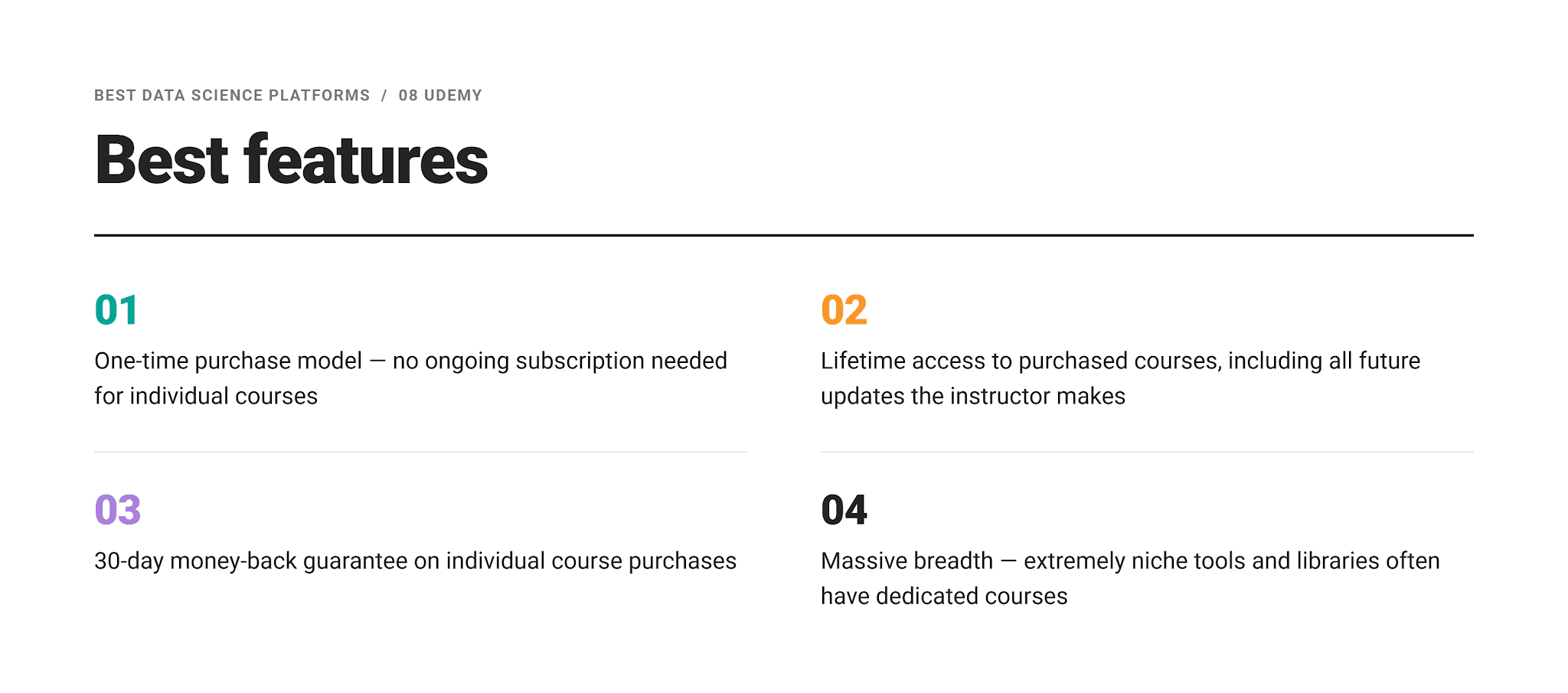
For data science specifically, there’s a virtually endless number of courses covering Python, SQL, machine learning, and specific tools (Tableau, Power BI, TensorFlow).
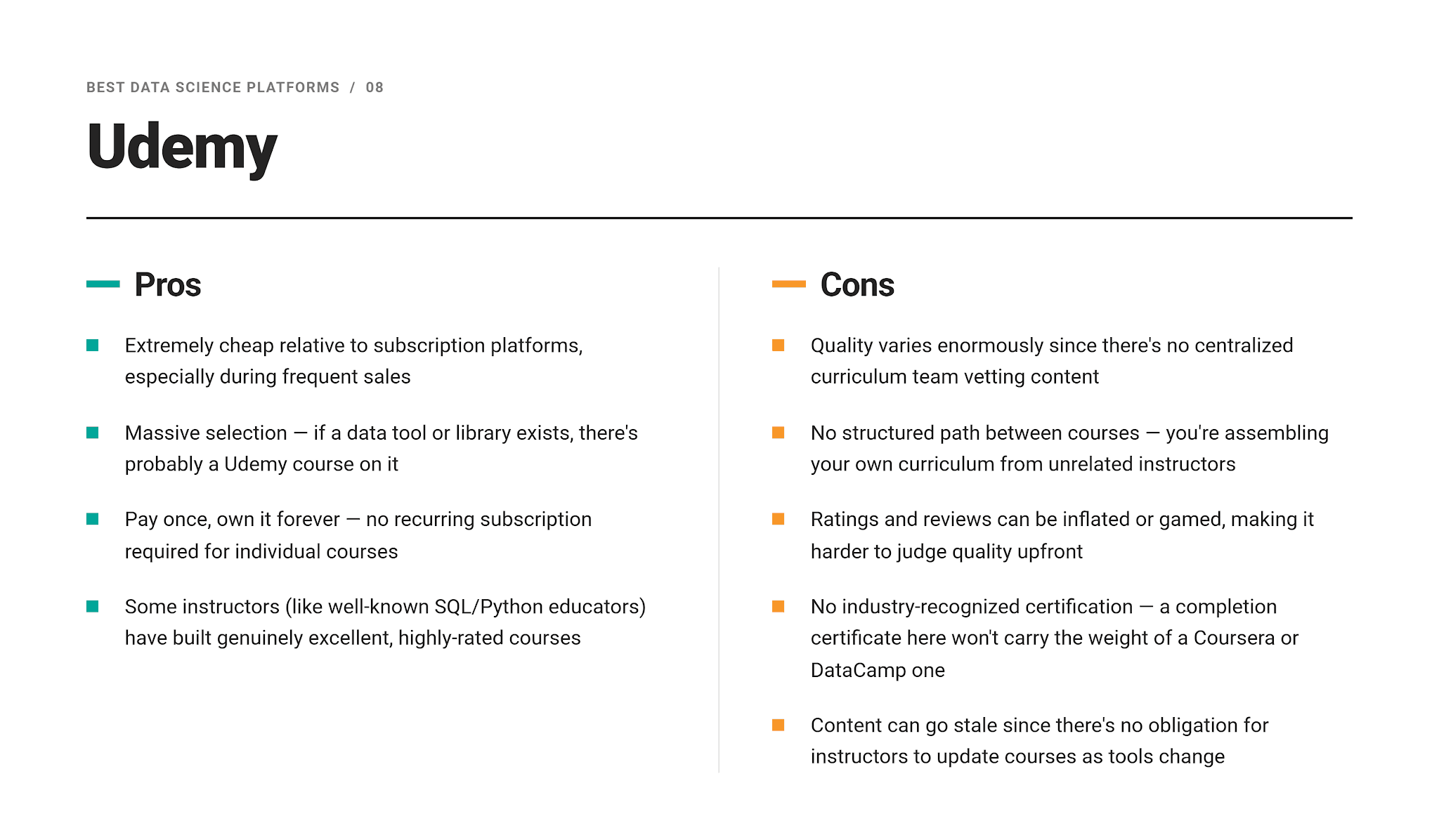
As the courses are taught by independent tutors, the quality and the price vary wildly.
The appeal is specificity. You're not paying for a subscription to a whole platform, you're paying once for one course on exactly the narrow topic you need, which is often cheaper than the cost for a single month elsewhere.
Pros & Cons
Pricing
Individual courses typically cost between $9.99 and $199.99. However, sales are common, bringing prices down to $9.99-$14.99.
A Udemy Personal Plan subscription (unlimited access to a curated course library) is also available, priced separately from à la carte purchases.
Best Features
Who Should Use It?
Anyone who knows what exactly they want to learn and doesn’t want to pay subscription fees for something they don’t use.
Also, it’s a good idea to use this platform to complement a broader curriculum with a course on a specific topic.
Who Shouldn’t Use It?
Anyone who wants a structured curriculum with consistent content and quality. Also, if you need an industry-recognized certification, Udemy’s completion certificate won’t be of any use.
Difficulty & Rating

9. DataLemur
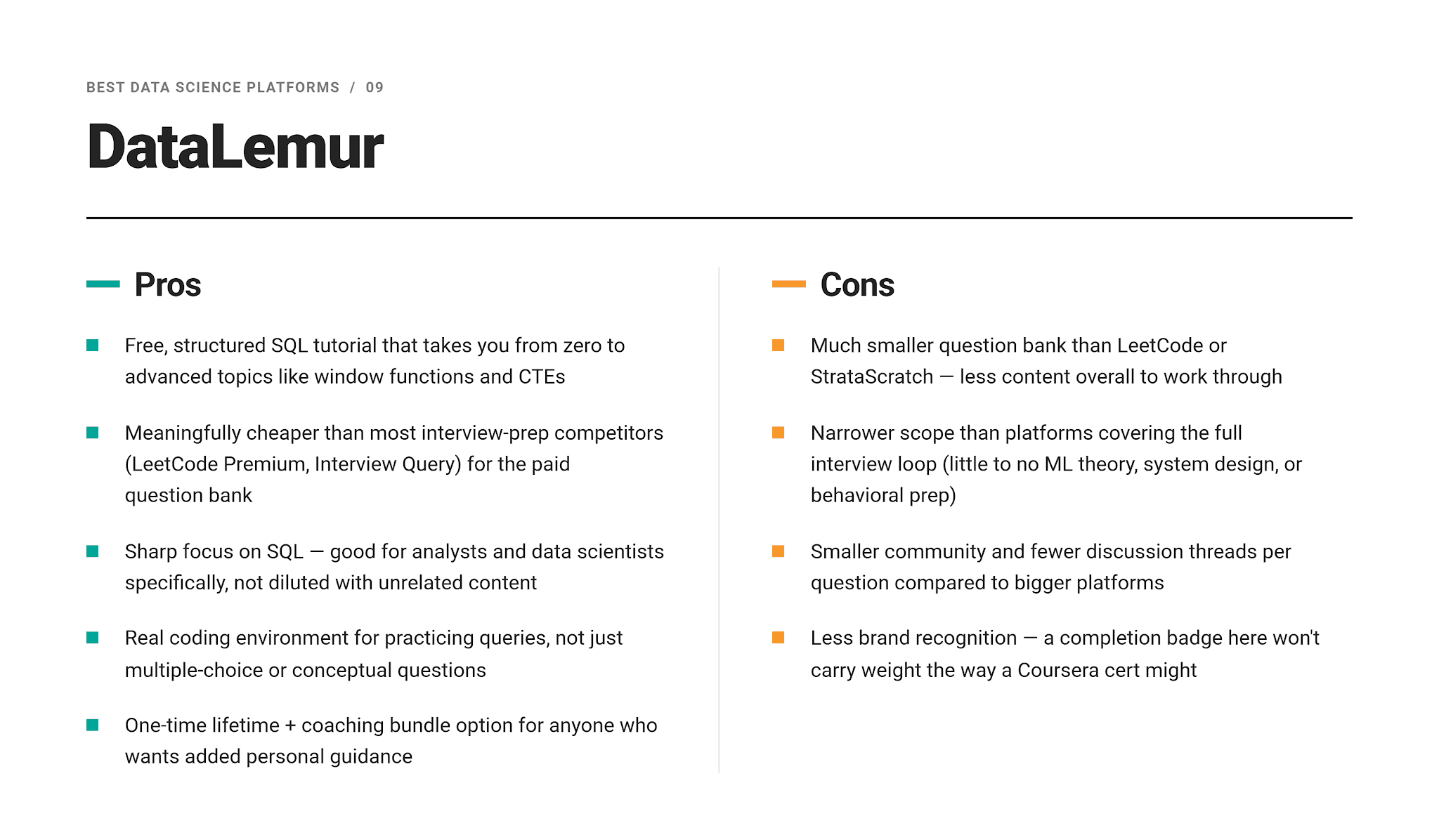
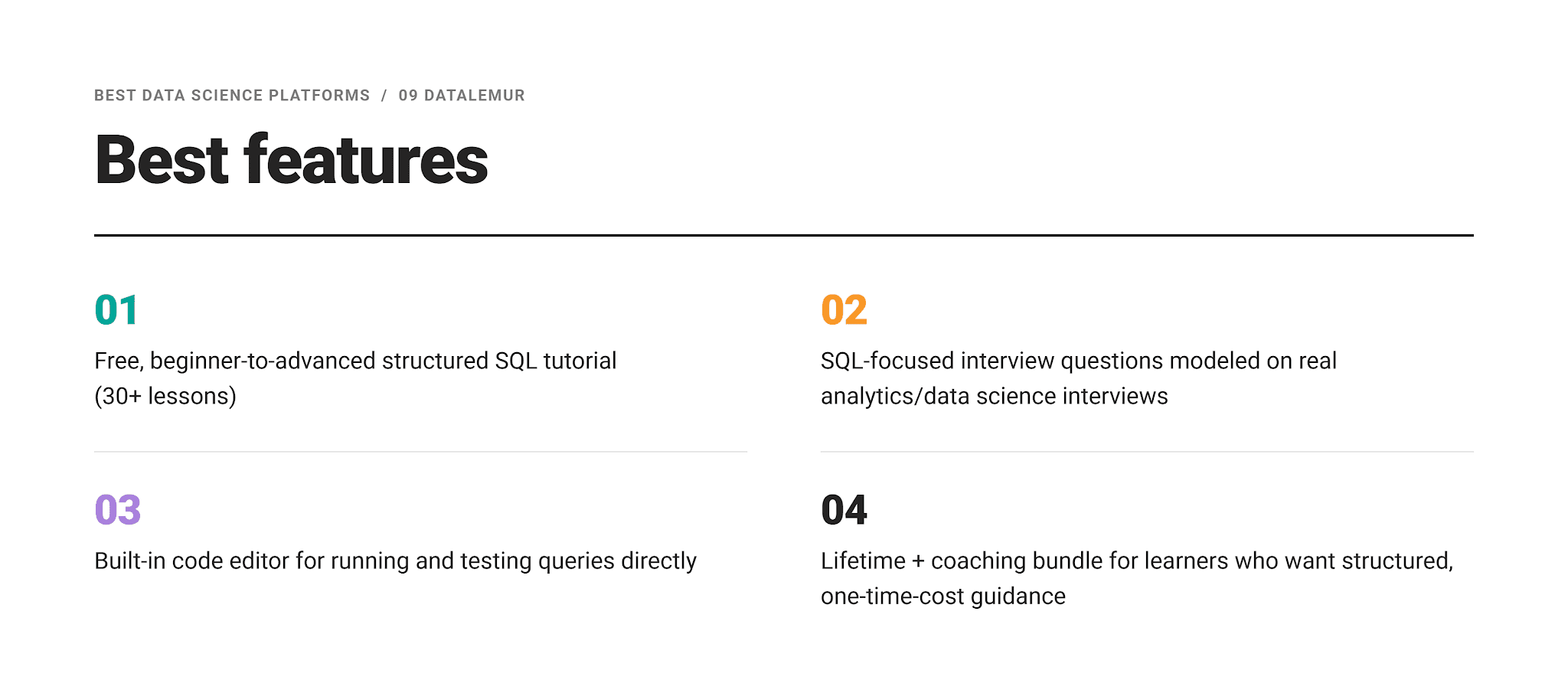
DataLemur pairs two things most competitors keep separate: a completely free, structured SQL tutorial (Basic → Intermediate → Advanced, covering everything from SELECT and WHERE) through window functions, CTEs, and pivoting) and a bank of SQL/analytics interview questions in a real coding environment.
You don’t need to know any SQL before starting with their tutorial. Then, you can move on to the interview-style practice questions.
Pros & Cons
Pricing
The SQL tutorial is entirely free with no login required. The interview question bank has a free tier with a limited number of questions.
The Premium subscription is $15/month or, if you choose a yearly subscription, $60/year ($5/month billed annually). There’s also a $300 one-time Lifetime subscription, including the one-on-one coaching and the author’s/owner’s signed book.
Best Features
Who Should Use It?
Anyone learning SQL from scratch and wanting to practice interview-style SQL questions cheaply.
Who Shouldn’t Use It?
Anyone wanting more diverse interview questions and topics covering something other than SQL.
Difficulty & Rating

10. HackerRank
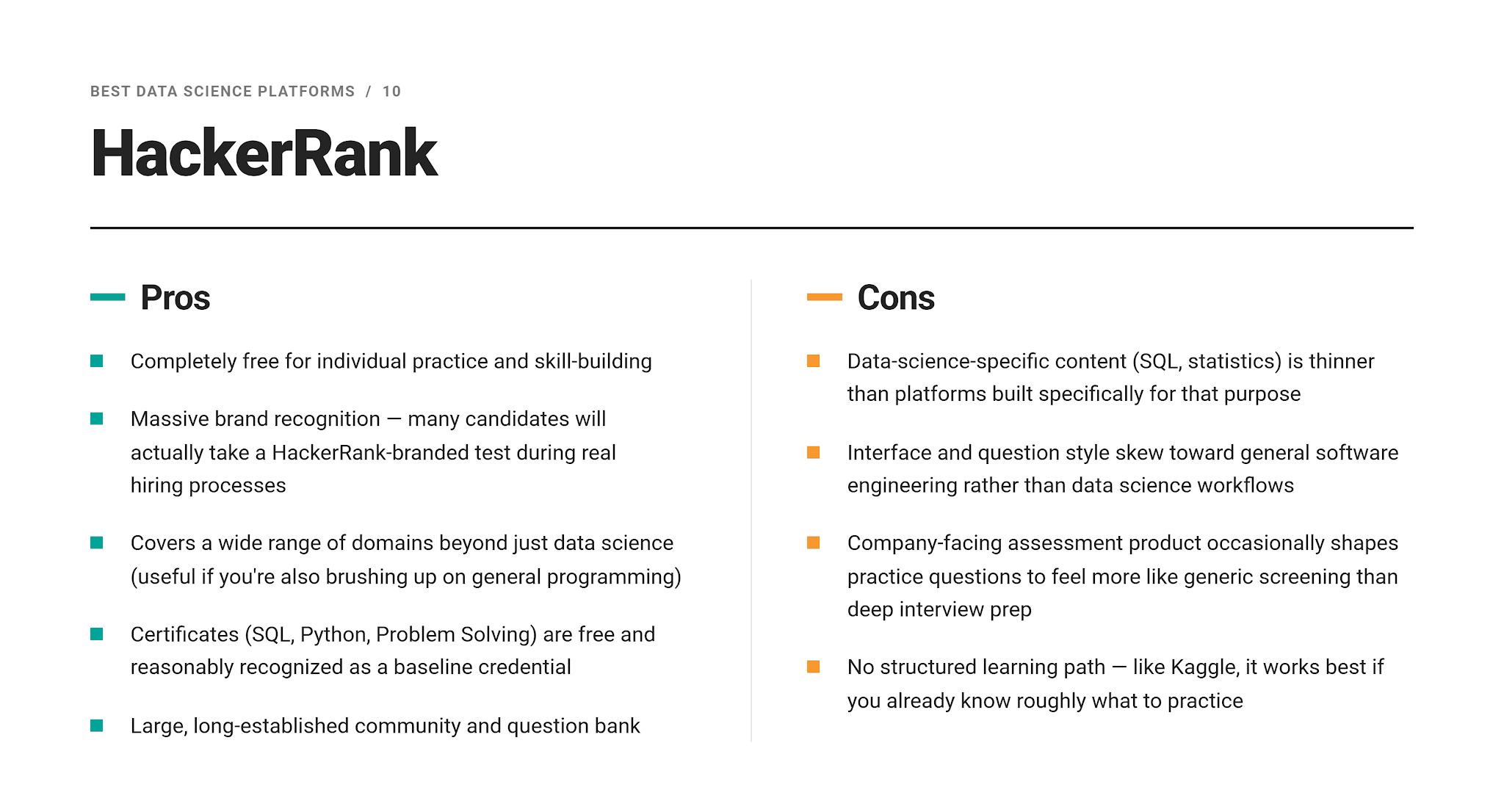
HackerRank is built for general software engineering practice and is now used by thousands of companies as an actual screening tool.
For data scientists, there are SQL, Python, and data structures/algorithms tracks, alongside broader domains like Java, C++, and general problem-solving.
The platform is simultaneously a free practice platform for individual developers and a paid recruiting/assessment product that companies use to screen candidates. This means that, as you learn, you’re using the same question bank companies use to build their actual hiring tests.
Pros & Cons
Pricing
Free for individual developers/job seekers, including practice problems, skill certificates, and community access. There are paid tiers, but they’re for recruiters/enterprises products for companies running assessments. You don’t need that.
Who Should Use It?
Anyone who wants free practice on the platform many companies actually use to screen candidates. Makes sure you’re not caught off guard before the actual screening.
Who Shouldn’t Use It?
Anyone looking for data-science-specific depth, such as advanced SQL, statistics, and ML.
Difficulty & Rating

11. Interview Query
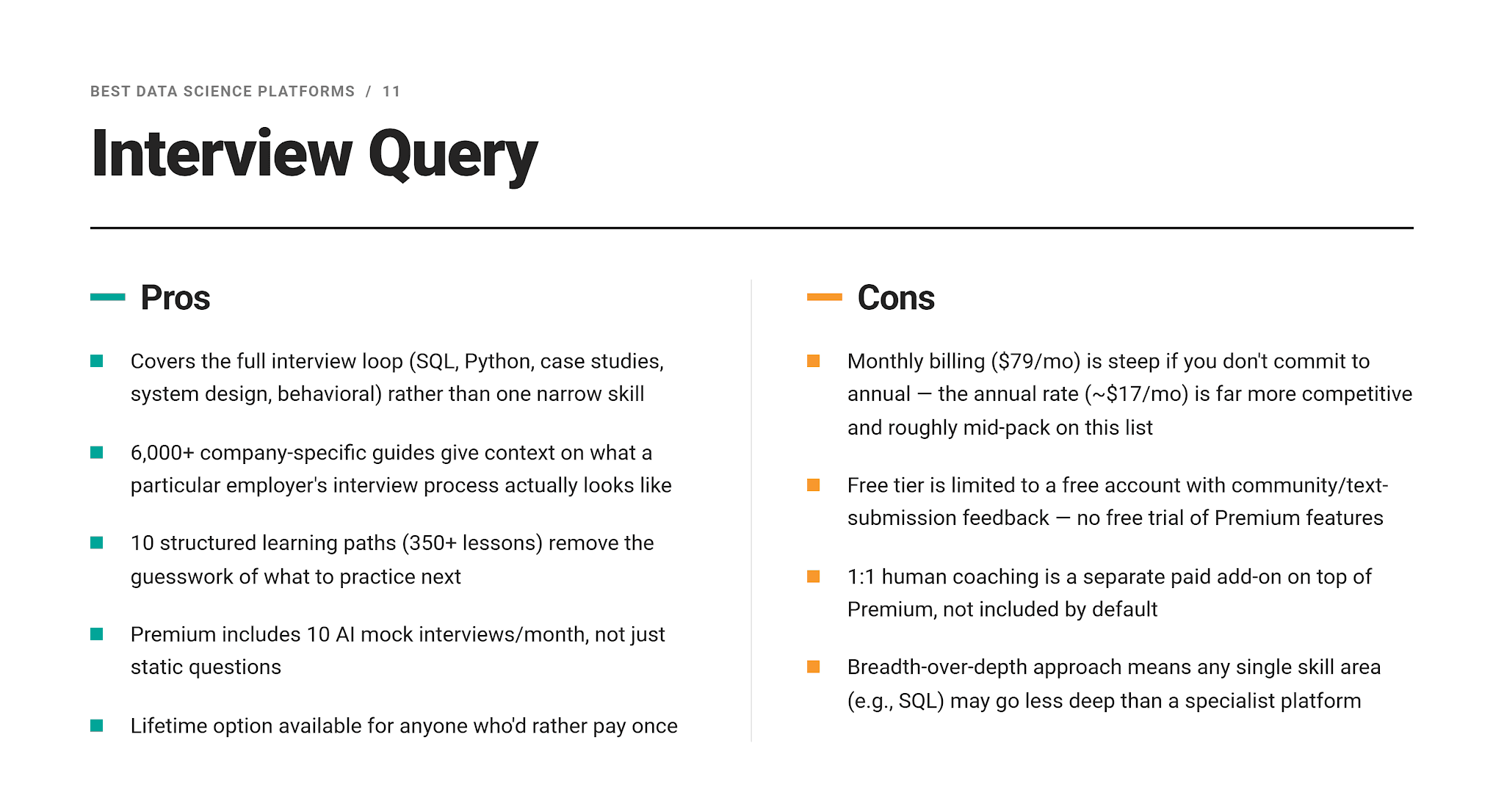
Interview Query is an end-to-end data science interview prep platform.
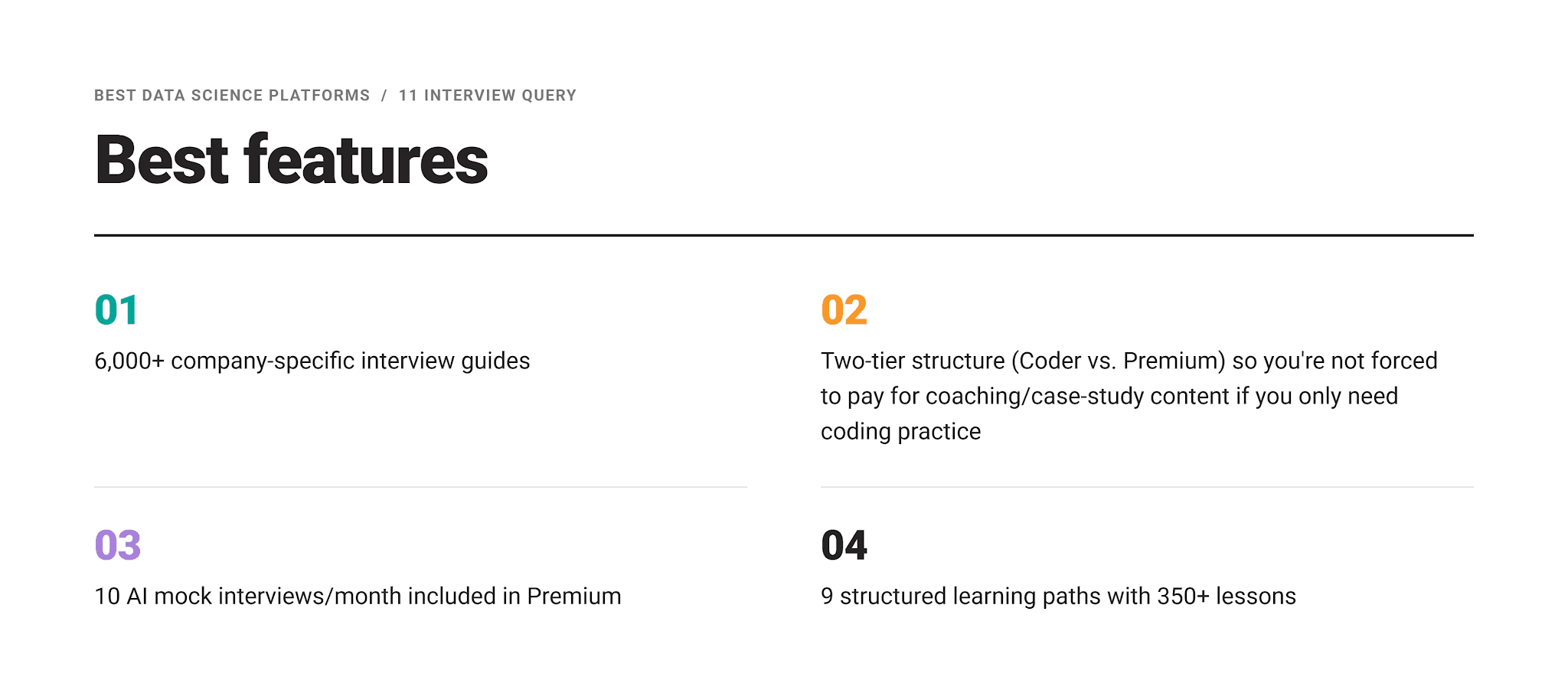
There are interview questions covering SQL, Python, statistics, and machine learning. Alongside that, they offer company-specific interview guides, structured learning paths, and – on its higher tiers – actual mock interviews and coaching, aiming to cover the full interview loop rather than just one round of it.
That breadth is their main advantage.
Pros & Cons
Pricing
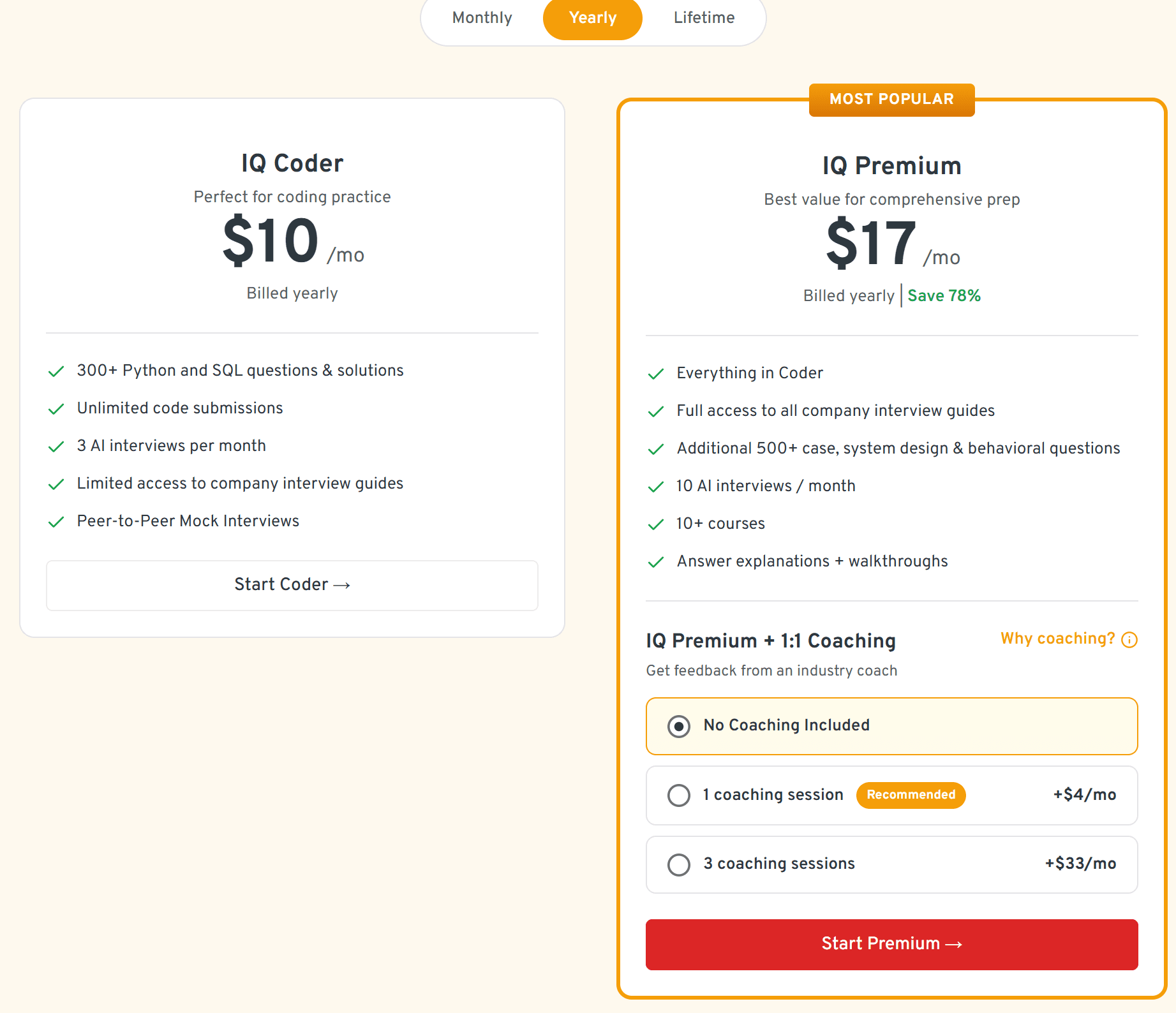
Free account available, with community access and text submissions, no premium content. Two paid tiers: IQ Coder at $29/mo billed monthly or $10/mo billed yearly, and IQ Premium at $79/mo billed monthly, $17/mo billed yearly. Add-on 1:1 coaching runs +$4/mo (1 session) or +$33/mo (3 sessions) on top of Premium. There’s also lifetime access priced at $299.
Best Features
Who Should Use It?
Anyone looking for a platform that covers the entire data science process.
Who Shouldn’t Use It?
Anyone who already has a study plan and just wants deep, focused practice in one specific area like SQL. (Admittedly, there’s the Coder subscription designed for that.)
Difficulty & Rating

Bonus Platforms
Beyond the 11 core platforms, these three are worth knowing about if you're targeting a specific cloud or vendor stack rather than general data science skills.
Databricks Academy
Databricks Academy is Databricks’ own training arm covering Spark, the Lakehouse architecture, and Databricks-specific tooling. The courses are self-paced and are the most direct path to a Databricks certification.
Pricing: Some courses are free. Others are $75 (Labs Catalog), $500 (blended learning catalog), and $1.500 (instructor-led courses).
Best for: Data engineers and data scientists whose job (or target job) runs on Databricks specifically.
Skip it if: You’re not working with Databricks/Spark or you’re looking for more general data science learning.
Difficulty & rating:
Google Skills
Google Skills is Google’s learning platform training you for GCP. It pairs short courses with interactive learning in an actual (temporary, sandboxed) GCP environment.
Pricing: Starter tier is free; you get 35 credits/month, limited hands-on labs, and skill badges. The Pro tier is $29/month for unlimited hands-on labs and courses at all levels, with a 7-day trial available for new subscribers.
Best for: Anyone whose (target) job uses GCP, e.g., BigQuery, Gemini Enterprise Agent Platform (ex-Vertex AI), Dataflow.
Skip it if: You target a different cloud computing stack (e.g., AWS or Azure) or more general data science knowledge.
Difficulty & rating:

Microsoft Learn
Microsoft Learn is Microsoft’s training platform for Azure, Power BI, Microsoft Fabric, and the broader Microsoft data stack. It is structured into learning paths and modules that map directly onto Microsoft certification exams.
Pricing: Training is free. Certification exams are $99-$165, depending on the certification.
Best for: Those who target Microsoft- or Azure-based role or a recognized certification.
Skip it if: You're not working in the Microsoft/Azure ecosystem, or you want hands-on practice with real datasets rather than vendor-specific tooling.
Difficulty & Rating:
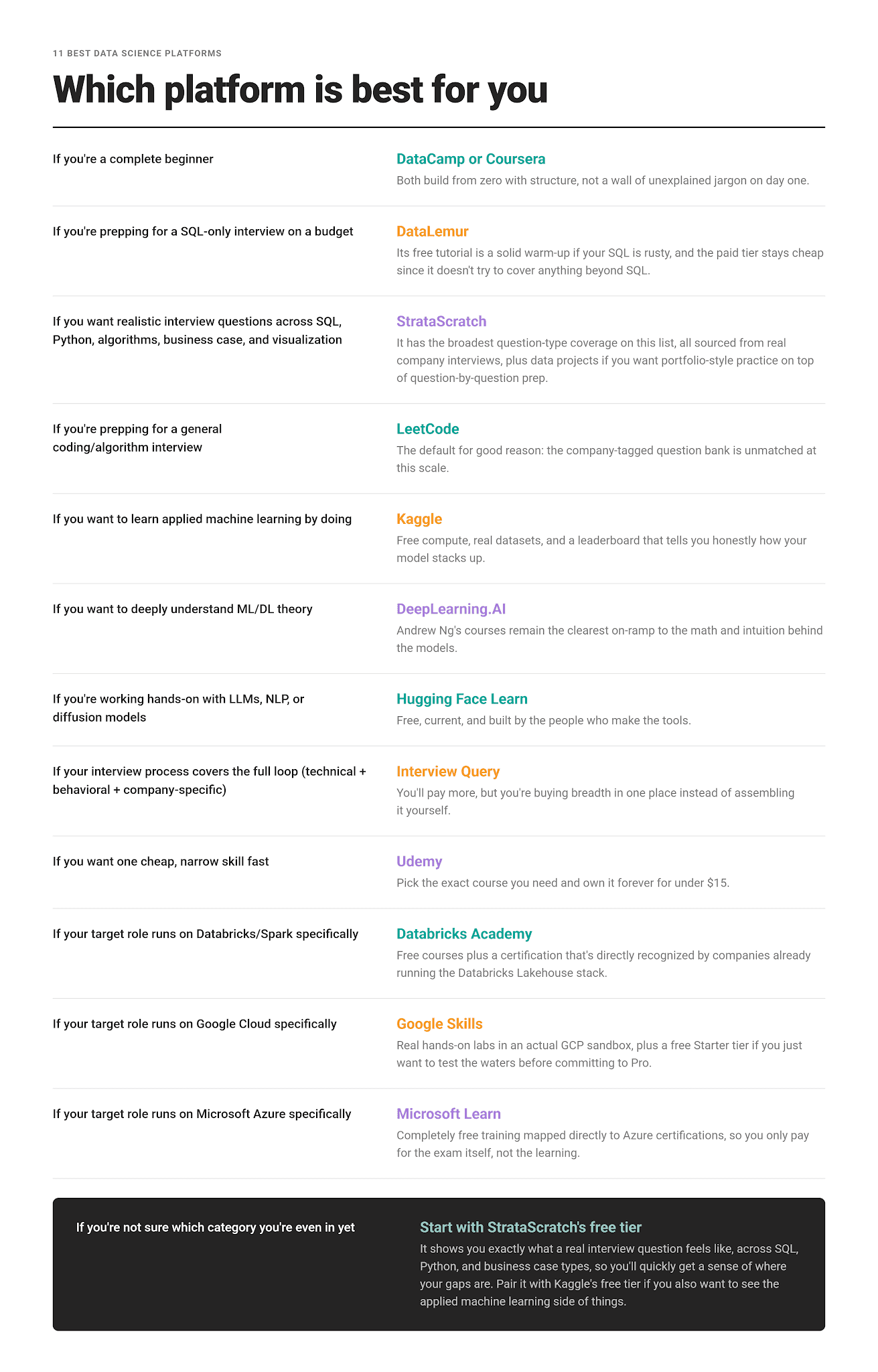
Which Platform Is Best For You
Now that you’ve seen the full breakdown, let’s now help you decide which platform is best for you.
Remember, no platform on this list is wrong nor are they below from the best to worst. The only real mistake is picking based on which one has the loudest marketing rather than what you're actually trying to get out of the next few months.
Conclusion
With information we provided, you’re well positioned to decide which platform is right for you. All the info you need is there.
With what we can’t help you (that much) is knowing what you want and need. Think about your needs, the context you’re learning in, the type of learning that will work well for you. Of course, think about your budget. Don’t pay for things that you don’t need. But, also, don’t pick a platform just because it’s cheap. Think about all the factors we talked about in the article.
FAQ
1. Which platform is best for beginners?
DataCamp and Coursera are the strongest starting points in terms of topics covered and providing structured learning. If you'd rather learn the fundamentals somewhere you'll also end up practicing for interviews later, StrataScratch's free SQL and Python learning path is worth starting with too, so you're not switching platforms once you're ready for real interview questions.
2. Is Kaggle enough to learn data science?
No. Kaggle is excellent for applied machine learning practice, free compute, and learning from other people's code. However, it doesn't teach SQL, statistics, or foundational concepts in a structured way.
If you insist on using Kaggle, then pair it with a structured course (DataCamp, Coursera) or a free resource like Kaggle Learn's short courses if you're starting from scratch.
3. Is DataCamp worth it?
Yes, if you're a beginner to intermediate learner who wants hands-on, in-browser practice. The Career Tracks and interactive format are genuinely well-built.
No, if you're already past the basics and want deep conceptual or research-level content.
Also, have in mind that, once you've built up the fundamentals, you'll want to pair it with a platform like StrataScratch to practice on real interview questions. There is no actual interview preparation on DataCamp.
4. Which platform is best for Python?
DataCamp for structured, beginner-friendly Python courses. Hugging Face Learn if you already know Python and want to go deep on ML/NLP applications specifically. LeetCode or StrataScratch if you want Python interview-style problem solving rather than a course.
5. Which platform helps with interviews?
StrataScratch and DataLemur for SQL-heavy data interviews, LeetCode for algorithm-heavy technical screens, and Interview Query if you want one platform covering the technical, case study, and behavioral questions.
6. Can I learn data science for free?
Yes. Kaggle, Hugging Face Learn, Microsoft Learn, and many Databricks Academy's courses are entirely free.
DataCamp, Coursera, StrataScratch, DataLemur, and Google Skills all offer meaningful free tiers to start with before you'd ever need to pay.
7. Which platform teaches AI for data science?
DeepLearning.AI for the theory and math behind machine learning and deep learning
Hugging Face Learn for hands-on, practical work with modern LLMs, NLP, and diffusion models.
8. Which platform is best for machine learning?
DeepLearning.AI if you want to understand the theory deeply.
Kaggle if you want to learn by building and competing with real datasets.
The best option? Use them both, as they cover both ends of how people actually learn ML.
Share